


Europe has committed to a 2030 target of 20 million ICT specialists. In 2024, it counted 10.3 million, which means the EU is over 9 million people short of its own ambition. Not exactly a problem you can outsource to a recruitment agency.
The shortage, however, is not confined to roles with “engineer” titles in them. The 2024 EU’s State of the Digital Decade report revealed that only 55.6% of people between the ages of 16 to 74 had “at least” basic digital skills, with an 80% target for 2030. The impact is showing up most evidently among SMEs. The EC’s 2023 Eurobarometer survey, “SMEs and Skills Shortages,” found skills shortages are a serious problem for 53% of micro companies, 65% of small companies, and 68% of medium-sized companies. The OECD calls it a ‘lose-lose situation for everyone’ because the effects of one gap create the next, forming an unavoidable chain reaction. If you can’t hire, projects slow. The pressure lands on the people you already have, and over time, that shows up in burnout, turnover, and a weaker competitive position.
Follow THE FUTURE on LinkedIn, Facebook, Instagram, X and Telegram
Basic digital literacy is necessary, but it’s not enough. The next gap is AI fluency. The World Economic Forum lists “AI and big data” among the fastest-growing skills. In the same report, skill gaps are highlighted as a major barrier to businesses staying competitive in the coming years. To keep up with the demand, the report estimates that out of every 100 workers, 59 would need to be reskilled or upskilled, and 11 would be unlikely to receive they need to remain employable.
Some companies and governments still talk about upskilling as the individual’s responsibility. The problem is that many people are willing to retrain, but they do not have the support to do it. A 2025 SHRM report states 86% of workers are willing to retrain, yet 56% say they do not have access to educational assistance or are not aware of the educational resources that is available to them. The report goes on to say that preparing the workforce “requires effective collaboration between workers, workers’ families, the government, employers, and schools and colleges.” That shared responsibility is also starting to peek in policy. European Commission guidance on AI literacy says the EU AI Act expects organisations that provide or deploy AI systems to take measures to ensure a “sufficient level of AI literacy” among staff and others operating those systems on their behalf.
Is collaboration enough to close a 9.7-million-person ICT talent gap by 2030? Or is the question we should be asking whether “collaboration,” using the current adult education and corporate training setup, can deliver the volume and pace required to reach the target? If not, we do not need another awareness campaign. We need a different, potentially revolutionary, learning model.
A revolution in education may be a stretch. But a platform that is serious about “dynamic, human-centered learning,” and is actually lowering the cost of personalized learning for millions of adults, may be the bridge Europe needs to close the gap between ambition and capacity.
DataCamp has spent more than a decade building interactive training for data skills and AI literacy. Over 18 million learners and 6,000 customers today use its platform. More recently, it has pushed toward personalized learning at scale. In November 2025, DataCamp acquired Optima to “bring the power of 1-1 tutoring to everyone.”
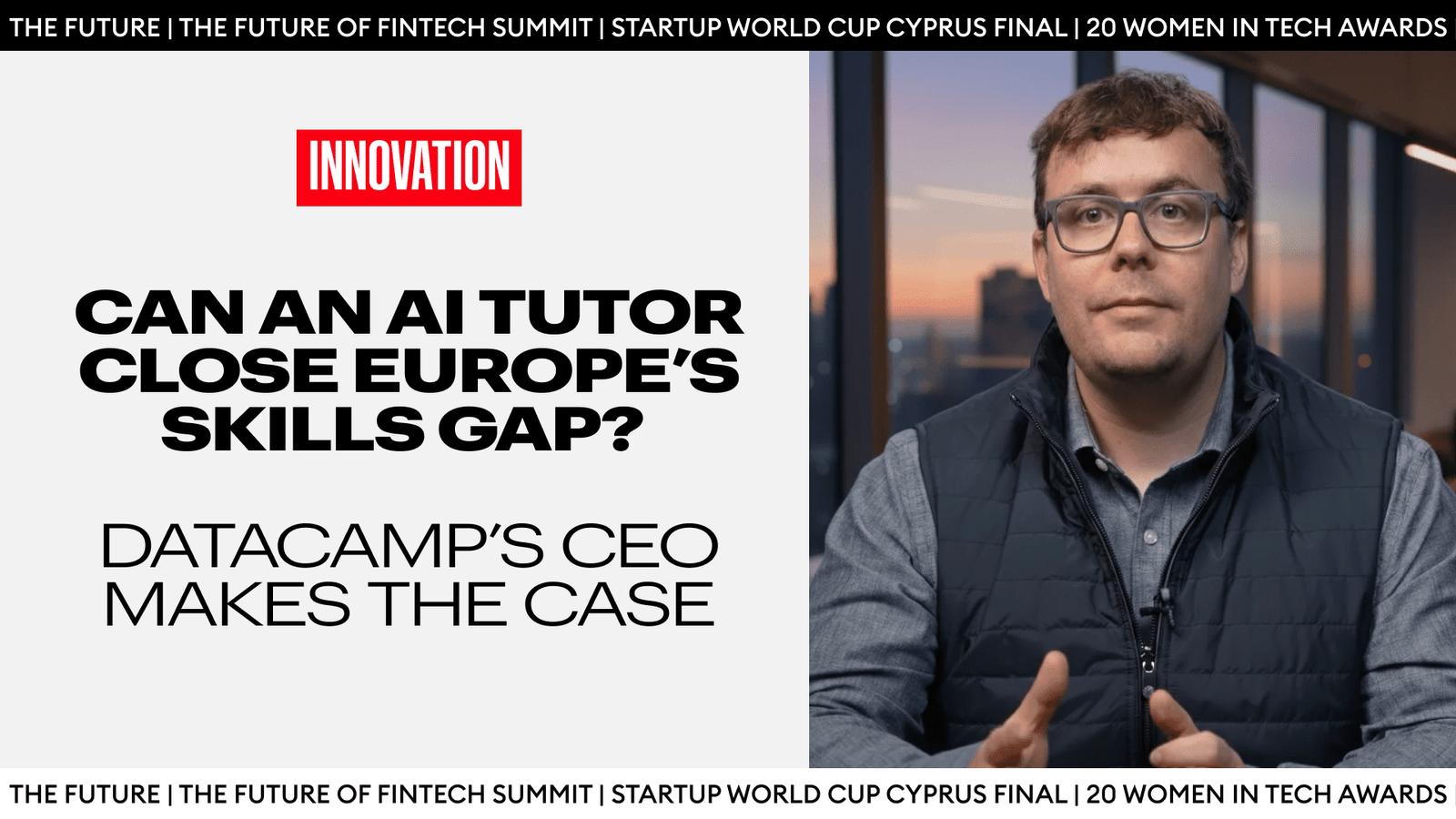
In this interview with The Future Media, CEO of DataCamp, Jonathan Cornelissen, talks through the business case for AI fluency, the human barriers that stall adoption, and what DataCamp’s Optima move reveals about the next phase of upskilling.
1. You started DataCamp before “data science” and “GenAI” became everyday buzzwords. Looking back, what problem were you solving then, and how has that evolved now that every boardroom is talking about AI and data skills?
It’s been a fascinating decade. I still remember when we were just getting started. Back in 2012, a Harvard Business Review article declared that the data scientist would be the sexiest job of the 21st century. There was a growing awareness that data science would be important.
But in practice, especially in Europe, it wasn’t that common for companies to have data scientists. At the time, many people were saying that everyone needed to learn how to code. Our perspective was that this may or may not be true, but what’s certain is that everyone would work with data regularly. But we also strongly believed that very soon, everybody would work with data regularly.
Even people who don’t necessarily consider themselves “data people” because everything was becoming digitized. As a result, there was data everywhere, in every sector and company. So, when DataCamp started, our focus was very much on data science and data teams, helping organizations build out their initial data capabilities.
With the emergence of GenAI, there’s been a tremendous surge of awareness at the leadership level around the importance of not just data skills and data literacy, but also AI skills and fluency. Over the last few years, we have expanded from serving data people and analytics teams to helping a much larger portion of the workforce build baseline data literacy and AI fluency and go further when they need to.
2. From your conversations with employers, what do you believe is the biggest internal barrier to investing in data and AI skills?
If you look at most organisations over the last 10 years, especially larger organisations, there’s been heavy investment in infrastructure to collect and store data, as well as in the tooling for analysis.
The biggest hurdles are the human factors: do people have the skills to understand what data should be collected, how it should be analyzed, and how it should be cleaned? And has the leadership bought in? Do they understand the value of data and AI skills?
There are a lot of organizations where historically decisions have been made based on who is higher in the chain of command. It’s a culture change to say, hey, we have data that can help drive these decisions.
But usually, if they’re not far on that journey, the bottleneck is people, culture, and skills, not the infrastructure. Now with AI, we’re seeing the same kind of trend. There are billions of dollars being invested in infrastructure, while organizations still need to invest in the humans.
We’re starting to roll out upskilling programs at a lot of larger organizations, but we’re still at the start of that journey. And if the innovation keeps moving as fast as it is right now, this will not slow down or stop.
What’s possible today and the skills you need already look different from a year ago. A year from now, it will shift again. Therefore, there’s a continuous need for upskilling and reskilling to keep pace.
3. How would you describe DataCamp and its mission to someone encountering the platform for the first time?
Our mission is to democratise data and AI skills for everybody. What differentiates our platform from say Coursera, Udemy, or other leaderboard players is that their content is often dense with theory and mostly video-based. You’re passively consuming information.
People learn by doing. On DataCamp, 80% of the time, you’re learning hands-on: writing SQL, using Python, or building an AI workflow in n8n.
And if you’re learning the basics of a GenAI tool such as ChatGPT or Copilot, we have courses where you’re practicing with them inside the platform. That active learning component has been our biggest differentiator.
This approach achieves several things.
First, it’s more motivating for people. We see that in our data. Our engagement rates tend to be higher than on video-based platforms.
Second, if you’re an employer or a school providing this training, it helps ensure learners gain the skill, and not just a certificate. The reality is, with video-based training, it’s very easy to let the video play in the background or skip ahead. It becomes just a matter of checking the box.
When it comes to data and AI skills, that’s not enough. You need active learning. With the Optima acquisition, we now have an additional advantage. The challenges learners face and the paths they take through the courses will be unique to each learner. If the course content is too easy or hard, the platform will adjust the content to make sure it is relevant to the learner’s needs, interests, and goals. It will also break the language barrier by supporting any language the model can reliably understand and generate.
For the first time, technology is getting closer to the best human teachers and eventually may even surpass the best human teachers. This is clearly the direction we’re heading over the next few years.
4. Based on DataCamp’s learner data, what does a “typical” learner look like today?
This is a hard question to answer because there isn’t really a typical learner. People who land on DataCamp come from very diverse backgrounds.
There are those with a technical or STEM background, but that makes up only 20-30% of our users. The majority come from non-technical roles like marketing, finance, customer support, research, and so on. Gender-wise, we’re roughly 60/40, so it skews a little male, but it’s much more balanced than many parts of tech.
We also have hundreds of thousands of students, typically college-level, because we offer the platform to teachers and professors who want to use it in a classroom setting. Large university pay but individual teachers can get a semester of DataCamp access for free.
When it comes to individuals, these usually fall into two camps: those who would like to accelerate in their careers, and those looking to change careers into roles like a data analyst, a data scientist, or an AI engineer. Approximately one-third of our users are career changers, but a large group are upskilling to move faster in their current careers.
Then we have the organizations. We do still help data and analytics teams, but most of our deployments now are enterprise-wide, where we help up-level the entire workforce.
So, if you ask me about the typical age, it’s between 25 and 45 for the last segments.
But then we also have the student segment, which is between 17 and 25. This is what’s exciting. The need for these skills is across industries, backgrounds, genders, and geographies. That speaks to the importance of the skill set.
5. You recently announced that you have completed the acquisition of Dubai-based Optima, an AI-native learning platform for building data and AI skills. What stood out about their AI tutor approach that led to the acquisition?
As I’ve mentioned, the original vision behind DataCamp was always that people learn by doing. We aim to make the experience as engaging and interactive as possible, with real-time feedback and a platform that adapts to the learner. Ten years ago, we didn’t have GenAI.
So, we built a lot of deterministic systems to do what GenAI now, to some extent, makes easier. The founder of Optima, Yusuf Saber, was actually a user of DataCamp. He has been a data leader at several tech companies in the UAE. At Optima, he and his team reimagined what learning can be now that we have GenAI, especially when it comes to personalizing and customizing the experience to the learner.
Their starting point was taking a DataCamp-style interactive learning experience and taking it one step forward with GenAI. I met Yusuf just by sheer coincidence when I was visiting a client in the UAE. At DataCamp, we were already thinking about moving in that direction, but the moment I saw what they had created, it felt like the best implementation I had ever seen. And I have seen a lot of companies claim to have an AI tutor, with very little success.
This was the first instance where I saw an implementation that moved beyond a chatbot and actually reconceptualized the whole experience. It was immediately clear that we either had to work together or we would be hardcore competitors.
Fortunately, we found a way to join forces and accelerate DataCamp’s AI strategy, while staying close to the original vision. The early indications are very positive. It’s a work-in-progress, but it’s a new foundation that can ultimately enable us to get to the point where it’s better than the best one-on-one human tutoring.
6. A lot of people, especially career switchers, struggle with confidence and “I’m not a data person.” What have you learned about lowering the barrier to entry?
That makes me so happy to hear that, because I think it’s really underestimated in education. The biggest hurdle a lot of people have is self-doubt and the belief that this is not for me. One of the things exceptionally good teachers always do is they gradually build up your confidence and show you that you can.
This is what DataCamp has been helping users overcome through that active learning experience. Users are guided step by step through each step and can see the results of their work. In that way, they can build up their confidence. The AI teacher takes that to the next level because it’s not only bite-sized, but it adapts to you.
If the tasks are too easy, the platform will adapt. If it’s a little bit too hard, again, it will adapt. That calibration builds a learner’s confidence more effectively.
Another fear a lot of people have is asking questions. They don’t want to look silly, or they’re worried about being judged. But with an AI coach, private, low-pressure space. Early research suggests that this kind of environment can reduce anxiety for learners and make them more willing to ask for help. We are seeing that dynamic already in how people use our platform. In some cases, even if an AI tutor isn’t “better” than a great human teacher, learners can be moreopen with it, and that extra back-and-forth can make the experience more effective for them. That’s the part I find fascinating.
7. Data privacy in Europe is non‑negotiable. As AI-native learning personalises content, how do you balance between having a better user experience for your learners and GDPR and data compliance?
When it comes to data privacy, we take it extremely seriously. It is our responsibility to ensure that our users’ data is safe, and we are staying as compliant as we can be.
Let’s break this down into individuals and organizations.
Ultimately, it comes down to customer choice. What we’re seeing is that when some users engage with our new AI-native experience, some are guarded and others are very open in sharing with the AI tutor. The good news is you can still gain a lot of value on a few basic questions, such as: What are your goals? What industry are you in? What is your current level?
At the same time, just like with a human tutor, the more you put into the system, the better it can understand your goals, your strengths and weaknesses, and where you need the most support. That improves personalization. Most consumers are fine with that trade-off and share quite openly. This is true for AI systems in general, not just education.
At the enterprise level, it’s quite interesting. We do see more scrutiny from European companies. Although we work with some of the largest financial institutions in the US, which have a very high bar for data privacy compliance, they’re still less stringent than some of our European enterprise clients. We’re still in the early phases of rolling out our AI native experience there.
I think the future for organizational learning is training that adapts not just to the industry, but to the individual organization, department, and even team, too. However, this means the level of scrutiny and the ethics around keeping that data safe will increase, especially when the data is deployed to the client’s infrastructure rather than on a central server. Those systems have to be designed with data privacy and compliance front and center. This is what we are working on.
8. Have you faced criticism around AI tutors replacing jobs? How do you respond to that fear?
There’s a lot of fear around people losing their jobs, and in some cases, that’s totally valid. Taking the example of AI drivers, like what Waymo and Tesla are building. There will be a point when we will no longer need a human driver to get from A to B, and those jobs will be replaced.
In education, we’re further away from the point where we can do without human teachers. That is not to say we are not seeing change. There are some curricula already delivered at least partly by AI. But we still need really good teachers, classrooms, and office hours to guide the students.
The role will evolve. AI will give really good teachers an incredible amount of leverage to focus on the areas where students still struggle and need human support.
We know the best way to learn is with a personal tutor. That’s the market demand, but only a very small group of people can afford that privilege. So in this instance, I think we’re not taking away value but filling a large gap that wasn’t being served.
9. Looking ahead, if DataCamp succeeds, what does the workforce look like in 2030? How do decisions get made, how are teams structured, and what changes when every employee can interrogate data?
This is a very hard question. My mental model is that AI gives every knowledge worker superpowers.
If you’re in marketing right now, you might rely on an engineering team to build marketing pages and materials. AI will let you build your own marketing website, vibe code it yourself. When it comes to data skills, you’ll see the same thing. You’ll have the experts doing really advanced work, but everyone else will be able to explore data and pull insights far more effectively.
There’s been a lot of talk about jobs becoming redundant or replaced, but less about the new jobs AI will create by 2030. I’d be lying if I said I fully understood what those roles will be. We’re starting to see hints here and there, but it’s still hard to imagine.
What I do know is that knowledge workers will be far more productive than they are today. And from a societal point of view, the way we avoid the doom scenarios is by changing the mindset around the technology, and empowering everyone with the skills to walk into the future.