

“At the end of the day, you can’t tell a child that an algorithm decided for them,” Rodoula Papalambrianou told an audience in Nicosia. “There must always be a person behind that decision, and people must remain responsible.”
Papalambrianou is the Scientific Coordinator of the Children’s House at Hope For Children CRC Policy Center, where professionals handle cases involving the sexual abuse of minors. Her warning brought the experience of children already living with the consequences of digital technology into a discussion about how governments may use AI.
Follow THE FUTURE on LinkedIn, Facebook, Instagram, X and Telegram
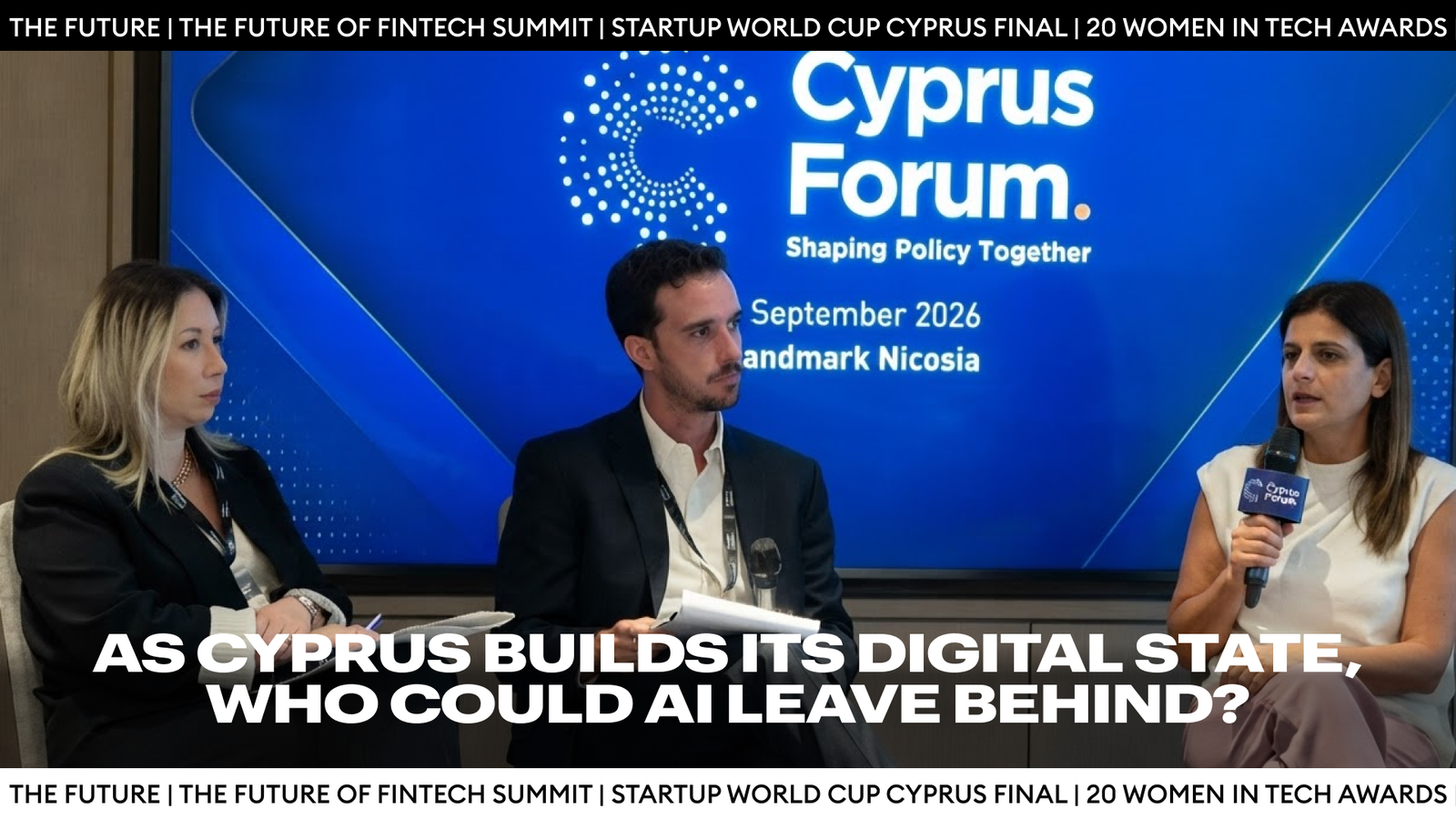
The discussion took place during Cyprus Forum 2026, held from 28 to 30 September at The Landmark Nicosia. Organised by Oxygen for Democracy, the annual independent, not-for-profit conference brings policymakers together with representatives from business, academia and civil society to debate public policy and reform.
One of this year’s panels, AI and Equal Participation: Who Shapes the Digital State?, examined who participates in developing public-sector AI and who may be overlooked when those systems are introduced.
Josie Christodoulou, the Republic of Cyprus Commissioner for Gender Equality, joined Papalambrianou. Andreas Demetriou, a founding member and Legal Advisor of AI³, chaired the discussion.
They considered what happens when technology trained on existing social patterns begins influencing public services. A system may help officials reach a decision, but someone must still answer for the consequences.
A digital state can still exclude people
The risks become more serious when an automated system influences access to benefits or other essential services.
Demetriou referred to the Dutch childcare-benefits scandal, in which an algorithm wrongfully profiled recipients as potential fraudsters. Thousands of families suffered severe financial and personal consequences.
The example showed how quickly a technical error can become a public decision with lasting negative effects. It also raised the question that any government using similar systems must answer before incorporating technology into their pipelines: how can a citizen challenge an automated conclusion?
For exclusion may begin with something as familiar as language, and this is especially relevant in the case of Cyprus.
Demetriou warned that AI systems unable to understand the Cypriot dialect could place some users at a disadvantage. A person comfortable with standard Greek or English may adapt to the system. However, an older person or a child who communicates differently may struggle.
“If AI is used in a digital state, I may be able to speak to it in English or Greek,” he explained. “But an older person or a child may have difficulty. That is where another inequality can be created.”
A digital service cannot be considered accessible simply because it is available online. It must also understand the potential users.
The biases AI inherits
“We are not starting this discussion by asking whether AI is biased. We are starting from the recognition that it is.”
Christodoulou said.
AI learns from material produced by people and from patterns established through earlier human decisions. Demetriou illustrated this with an example. If a system is trained on books in which doctors are consistently men and nurses are women, it is likely to reproduce that association when making its own predictions.
Who develops and tests the technology, therefore, is key to the future of the dynamics and socioeconomic wellbeing of society. Women represented only 19.5% of ICT specialists in the EU in 2025, according to Eurostat. This number could decrease if stereotypes persist.
Christodoulou said her office was working with the Ministry of Education to train career advisers on gender equality and conscious and unconscious bias. Girls who want to pursue science or technology should not be discouraged by the assumptions of the adults advising them.
“Stereotypes begin from the moment we learn the sex of our child, before that child is even born,” she said.
Bringing more women into technology is only one part of the solution, however. Christodoulou also called for more women in management and on company boards, where they can influence decisions about which technologies are developed and how they are used.
Children already trust the technology
Papalambrianou brought the discussion back to the children encountered through the Children’s House.
Many use AI applications without fully understanding their risks, she said.
“They trust the technology completely. They do not question it.”
That trust is not only limited to the information provided by an AI tool. Some children are beginning to give conversational systems a role resembling a human relationship.
“Children sometimes describe it as a trusted friend, an available adult, an adult who is always there to listen,”
Papalambrianou said.
AI can also be used to create sexualised images, facilitate grooming or circulate abusive material. Children may become victims, but they may also produce or share harmful content without understanding its consequences or how difficult it can be to remove.
The panel considered whether age restrictions could offer protection. Papalambrianou cautioned against presenting the choice as either unrestricted access or a complete ban. Children already use these technologies. Excluding them from discussions about how the systems work would leave adults designing protections without fully understanding their experiences.
Any response must also account for differences between children. Those with intellectual disabilities or experiences of violence and social exclusion may interpret warnings, consent requests, and online risks differently. Parents and educators need training, but education alone will not protect every child.
Responsibility cannot be automated
Christodoulou called for female role models in technology and for men to help dismantle the stereotypes that restrict women’s choices.
“Equality between women and men is not a competition between the sexes, nor is it about so-called gender wars. It is about equal access, equal opportunities and equal participation.”
she said.
People should not enter the discussion only after a system has been purchased or introduced. Their experiences need to be considered while public services are being planned and tested.
AI may assist a government decision. However, it cannot assume responsibility for what follows. That remains with the public bodies and officials who choose to use it.
Quotations have been translated from Greek.