Cyprus has slipped three places to rank 40th out of 167 countries in the 2024 Global Democracy Index, a stark signal of the challenges facing modern democracies worldwide. Developed by the Economist Intelligence Unit, the index classifies Cyprus as a “flawed democracy”—a label shared with nations like Malta, France, the US, Israel, and Serbia. While Cypriots enjoy robust electoral processes and civil liberties—with scores of 9.17 and 8.82, respectively—there are glaring weaknesses. Cyprus’ functioning of government languishes at just 5.36, the lowest among the top 50 nations, reflecting persistent gridlock, corruption, and a growing disconnect between elected officials and the public.
The Anatomy of Democratic Decline
The index, which evaluates countries across five dimensions—electoral process and pluralism, functioning of government, political participation, political culture, and civil liberties—reveals that despite high scores in voting and individual rights, Cyprus faces significant hurdles in governmental performance. Experts warn that outsourcing decision-making to non-elected bodies, from central banks to courts, has further eroded public trust. As citizens feel increasingly disenfranchised, confidence in democratic institutions continues to wane, casting doubts on the ability of traditional systems to deliver effective governance.
Follow THE FUTURE on LinkedIn, Facebook, Instagram, X and Telegram
Global Context and Regional Comparisons
The broader global picture is equally concerning. Out of 167 countries, 83 registered declines in democratic performance in 2024, while only 37 showed improvement. With over 39% of the world’s population now living under authoritarian regimes—a figure on the rise—many advanced democracies are struggling to meet citizens’ expectations. Western Europe, despite boasting the highest average scores and a quick recovery to pre-pandemic levels, is not immune. Recent elections across the region have highlighted a backlash against incumbents, as voters increasingly lean towards anti-establishment and populist parties.
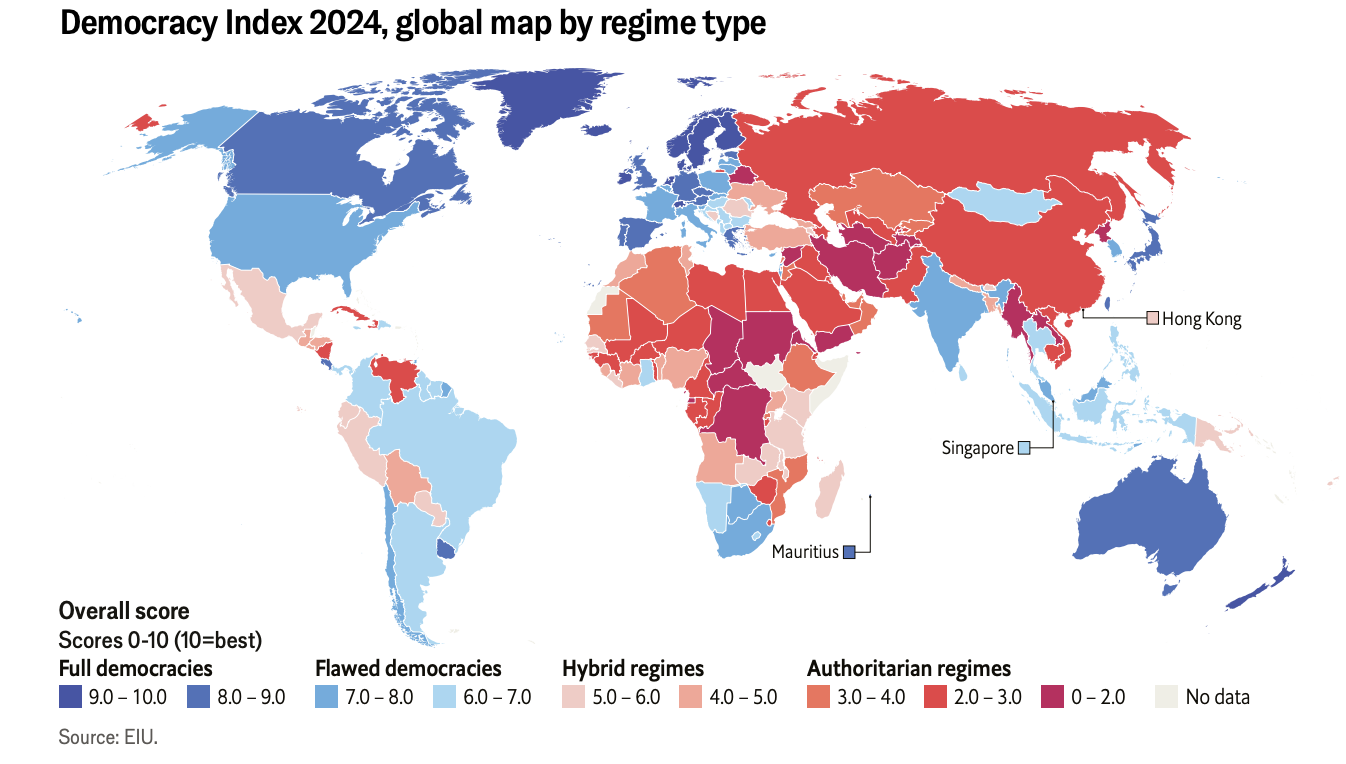
Norway, New Zealand, Sweden, Iceland, and Switzerland continue to set the gold standard as “full democracies,” while at the opposite end, conflict-ridden and authoritarian states like Afghanistan, Myanmar, North Korea, the Central African Republic, and Syria illustrate the extremes of democratic decay.
Implications for Cyprus
For Cyprus, the numbers are a mixed bag. With an overall score of 7.38—down three places from last year—and a rank of 22nd among the 27 EU member states, the country excels in electoral processes but lags in effective governance. This imbalance could further undermine public trust, especially if political leaders fail to engage citizens meaningfully in decision-making processes. The report underscores that formal democratic institutions alone are insufficient; a vibrant, responsive democracy demands an active, engaged electorate and leadership that genuinely addresses the concerns of its people.
Looking Forward
The 2024 Democracy Index serves as a wake-up call: while Cyprus retains strengths in ensuring free and fair elections, urgent reforms are needed to enhance governmental performance and restore public confidence. As the global democratic fabric continues to fray—with more than one-third of the world’s population under authoritarian rule—the challenge for Cyprus is clear. Addressing inefficiencies, increasing transparency, and fostering genuine citizen participation are not just ideals but imperatives for a resilient future.
Cyprus’ democratic journey, much like its economic and technological endeavors, will depend on its ability to evolve and meet the expectations of a modern society. In a rapidly changing world, ensuring that democracy delivers tangible benefits to citizens is the ultimate measure of success.





