Breaking news

How Many Months of Salary Do You Need to Buy a House in Europe?

The answer depends largely on where you live. A recent report by BestBrokers compares property prices across Europe to average salaries, offering insights into how many months of income it would take to afford a home.

Where in Europe is Buying a Home Most Affordable?

Denmark leads the pack as the most affordable country in Europe for homebuyers. According to the report, purchasing a 100-square-metre property in Denmark costs the equivalent of 114 net monthly salaries, making it the shortest saving time in Europe.

The report considered factors such as average net income, inflation, and “real” mortgage interest rates—mortgage rates adjusted for inflation. It’s important to note that the calculation assumes no spending on food, housing, childcare, or other expenses, offering a purely theoretical outlook.

Interestingly, despite ranking as Europe’s most affordable housing market, Denmark also holds the title of the most expensive EU country for goods and services, with prices 43% above the EU average in 2023, according to Eurostat. Still, Denmark’s relatively high average earnings—seventh in Europe—offset these costs.

Following Denmark, Ireland, and Sweden rank as the second and third most affordable European countries to buy a home. A 100-square-metre property costs the equivalent of 123 and 129 net monthly salaries in these nations, respectively—roughly 10 years of annual earnings.

Which European Countries Make Saving for a Home the Hardest?

At the opposite end of the spectrum are the Czech Republic and Slovakia, where saving for a home takes considerably longer. In Slovakia, for example, buying a 100-square-metre property costs 297 net monthly salaries—nearly 25 years of earnings. Even if someone managed to save half their income every month, it would take 50 years of disciplined saving to afford a home.

Where Are Homes the Most Affordable Globally?

Globally, South Africa emerges as the most affordable country to buy a home. A 100-square-metre property costs 71 times the average monthly salary, making it the fastest place in the world to save for a house. The United States comes second, requiring 76 monthly wages—equivalent to approximately six years of annual income. However, property affordability varies greatly between states in the U.S., with some regions significantly more expensive than others.
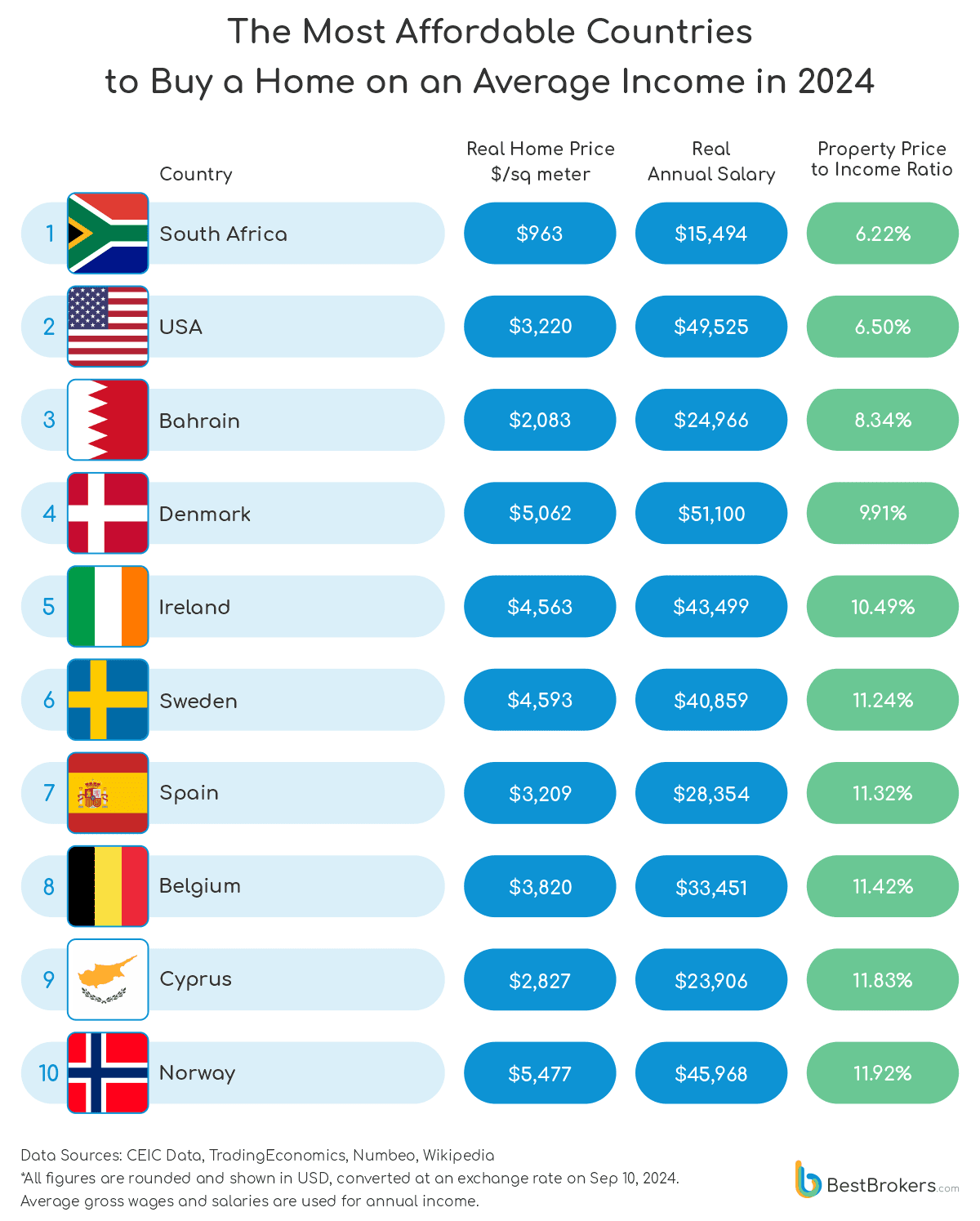
image 34

The World’s Least Affordable Housing Markets

On the flip side, Nepal holds the title for the least affordable housing market, where a 100-square-metre home costs a staggering 684 monthly salaries. Turkey follows closely behind, with homes priced at 631 net wages, or over 52 years of income.
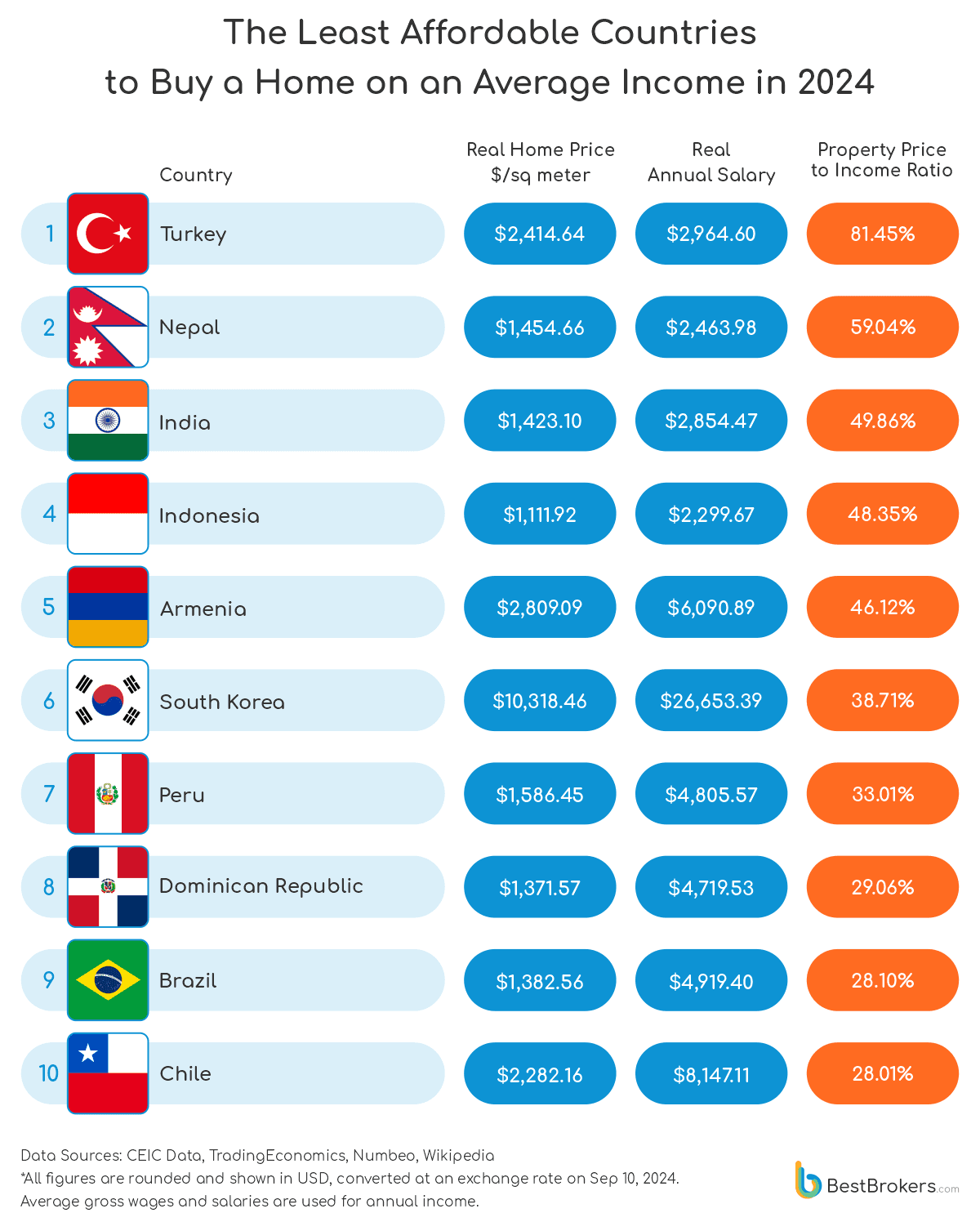
image 33

How Many Monthly Salaries Does a 100-sq-metre Home Cost Around the World?
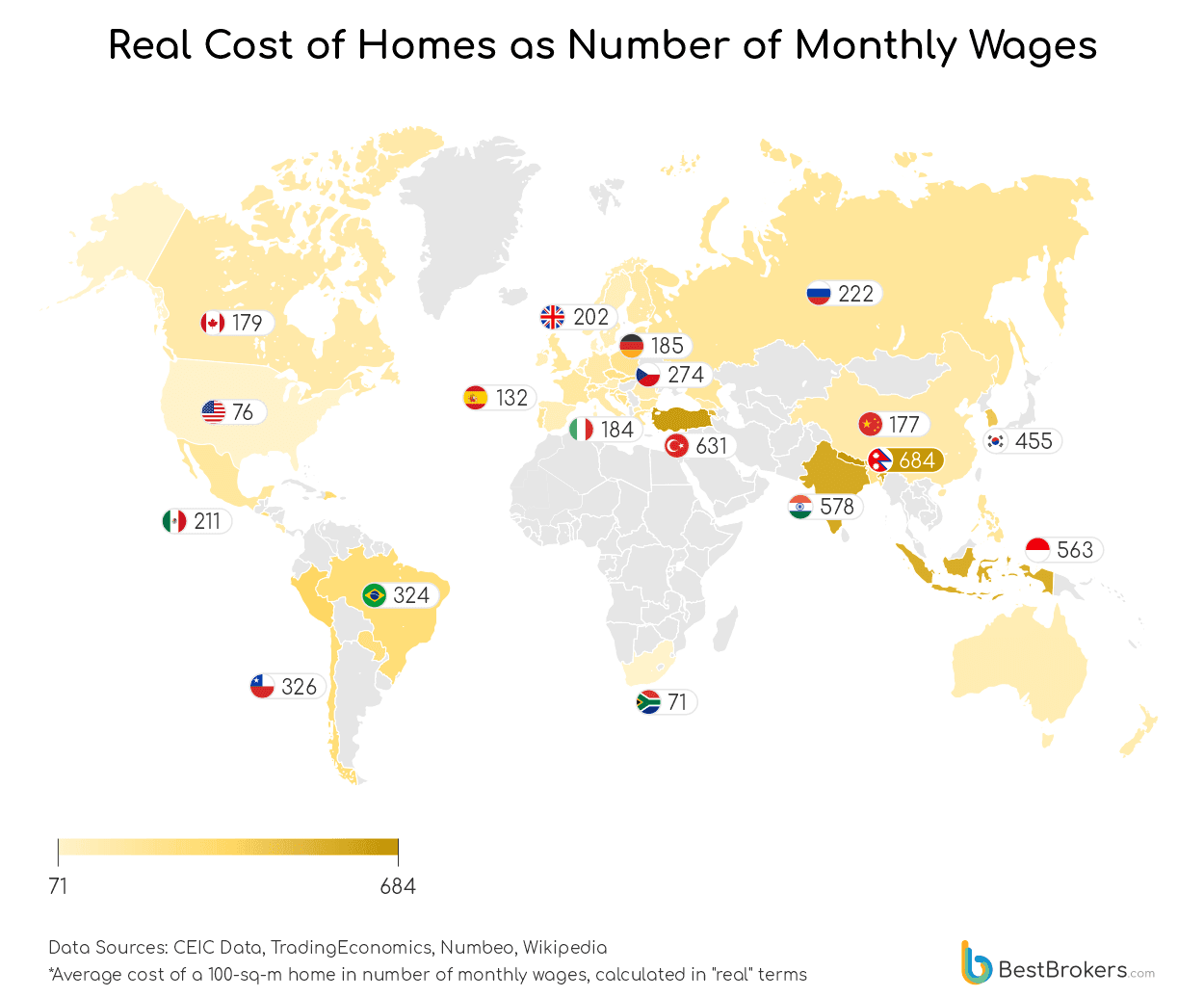
image 32

Final Thoughts

This report sheds light on the stark disparities in housing affordability across Europe and the world. Whether you’re planning to buy a home in Denmark or dreaming of saving in Slovakia, understanding the cost-to-salary ratio is crucial for making informed financial decisions.

Disclaimer: The information provided does not constitute financial advice. Always conduct your own research to ensure it aligns with your personal circumstances. While we strive to deliver expert-backed guidance, reliance on this content is at your own risk.

Cyprus Residential Market Surpasses €2.5 Billion In 2025 With Apartments Leading the Way

Market Overview

In 2025, Cyprus’ newly built residential property market achieved a remarkable milestone, exceeding €2.5 billion. Data from Landbank Analytics indicates robust activity countrywide, with newly filed contracts reaching 7,819, including off-plan developments. This solid performance underscores the market’s resilience and dynamism across all districts.

Transaction Breakdown

The apartment sector clearly dominated the market, constituting 81.6% of transactions with 6,382 deals valued at €1.77 billion. In contrast, house sales represented a smaller segment, encompassing 1,437 transactions and generating €737.9 million. The record-high transaction was noted in Limassol, where an apartment sold for approximately €15.2 million, while the priciest house fetched roughly €6.2 million.

Regional Analysis

Nicosia: The capital recorded steady domestic demand with 2,171 new residential transactions. Apartments accounted for 1,836 deals generating €349.6 million, compared to 335 house transactions worth €105.5 million, anchoring Nicosia as a core market with average values of €190,000 for apartments and €315,000 for houses.

Limassol: As the island’s principal investment center, Limassol led overall activity with 2,207 transactions. Apartments dominated with 1,936 sales generating €824.1 million, while 271 house transactions added €157.9 million. The district enjoyed premium pricing, with apartments averaging over €425,000 and houses around €583,000.

Larnaca: This district maintained robust activity with a total of 2,020 transactions. The apartment segment realized 1,770 transactions worth €353 million, and houses contributed 250 deals valued at €96.3 million. Average prices hovered near €200,000 for apartments and €385,000 for houses, positioning Larnaca within the mid-market bracket.

Paphos: With a more balanced mix, Paphos completed 1,078 transactions. Ranking second in overall value at €503.2 million, the district saw house sales generate €287.8 million and apartments €215.4 million. Consequently, Paphos achieved the highest average house price at approximately €710,000 and an apartment average of €320,000, emphasizing its premium housing profile.

Famagusta: Distinguished by lower transaction volumes, Famagusta was the sole district where house sales outnumbered apartment deals. Out of 343 transactions, 176 involved houses (yielding €90.4 million) and 167 were apartments (at €32.4 million). The segment’s average prices were about €194,000 for apartments and over €513,000 for houses, signaling its focus on holiday residences and coastal developments.

Sector Insights and Forward View

Commenting on the report, Landbank Group CEO Andreas Christophorides remarked that the analysis demonstrates an ecosystem where apartments are the cornerstone of the real estate market. He emphasized, “The apartment sector is not merely a trend; it is the engine powering the country’s real estate market.” Christophorides also highlighted the diverse regional dynamics: Limassol leads in apartment pricing, Paphos commands premium house prices, Nicosia remains pivotal to domestic demand, Larnaca sustains competitive activity, and Famagusta caters to holiday home buyers.

In a market characterized by these varied profiles, informed monitoring of regional and sector-specific dynamics is crucial for investors aiming to make targeted and strategic decisions.

The Future Forbes Realty Global Properties
Aretilaw firm
Uol
eCredo

Become a Speaker

Become a Speaker

Become a Partner

Subscribe for our weekly newsletter
