


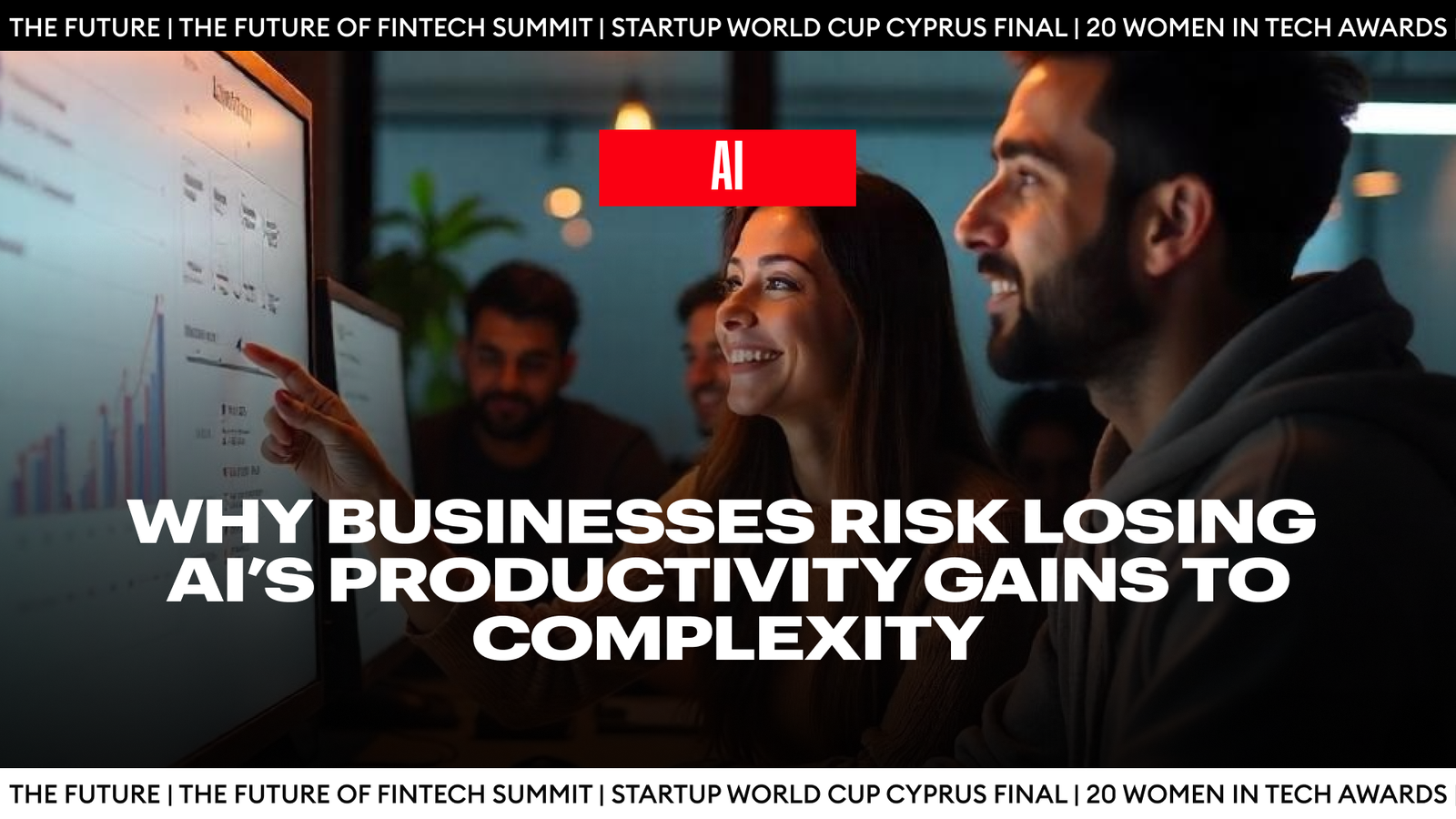
Artificial intelligence is helping companies produce more with fewer resources, but higher productivity does not automatically translate into stronger profits or sustainable growth. Many businesses are struggling to turn efficiency gains into lasting value as operational complexity, skills shortages and insufficient workforce investment absorb the capacity created by AI.
That is the central warning of the latest EY-Parthenon CEO Outlook survey. Almost all surveyed chief executives reported productivity gains over the past 12 months, measured by their ability to generate more output per employee. Nearly half said they were reinvesting those gains in growth, innovation or transformation. However, almost a quarter reported that the benefits were being absorbed by regulatory obligations, risk management, operational complexity and additional workloads.
Follow THE FUTURE on LinkedIn, Facebook, Instagram, X and Telegram
The AI Dividend Depends On What Companies Do Next
The findings come as executives navigate slower economic growth, geopolitical uncertainty and rapid technological change. With investment in AI accelerating, business leaders face a critical question: how can they turn new capabilities into sustainable growth?
According to EY, the answer goes beyond adopting technology. Companies need to redesign operating models, reorganise workflows and deliberately direct the capacity AI creates towards higher-value activities.
“The real AI dividend is not simply lower cost but greater and better output,” the report states. The next productivity divide will separate companies that reinvest newly available capacity from those that allow it to disappear into inefficient processes and growing complexity.
AI tools are most effective when integrated into redesigned workflows rather than simply added to existing systems. A North American wealth and asset management CEO described how the company requires every AI project to have a named business sponsor and undergo a formal review after 90 days, with the option to discontinue it.
“Two of our first five projects were discontinued,” the executive said. “That discipline is what makes the returns from the remaining projects credible, and it is the step many firms skip.”
Measure Business Outcomes, Not AI Activity
One of the main challenges is demonstrating whether productivity improvements actually benefit the business. Completing a task faster does not necessarily mean lower operating costs, higher output, better customer experiences or stronger cash generation.
Companies need to connect time saved through AI to measurable financial and operational outcomes. Legacy technology can make this difficult, but management structures and unnecessary approvals can also preserve inefficiencies even when individual tasks become faster.
EY recommends measuring business results rather than technology adoption, redesigning workflows to remove redundant processes while retaining human judgement, and deciding in advance how productivity gains will be used, whether for expansion, innovation, workforce development or shareholder returns.
Financial visibility remains limited. Only 16% of CEOs reported having detailed, real-time insight into AI costs and high confidence in assessing returns on investment. Another 56% said they had reliable visibility into most costs and reasonable confidence in their returns.
A meaningful assessment must go beyond AI model fees. It should include cloud infrastructure, data, integration, cybersecurity, governance, process redesign and employee training, as well as the cost of running new and legacy systems simultaneously.
“The pace of adoption will depend not only on what the technology can do, but whether the value created by each token exceeds its cost,” said Gregory Daco, EY-Parthenon chief economist.
Without clear financial measures, AI initiatives may meet technical targets while weakening business performance as they scale.
AI Will Reshape Work, Even If Headcounts Hold
The survey also points to significant changes in how companies organise work. Four in five CEOs expect AI to affect job roles, skills and working structures more than overall workforce size over the next three years.
As AI agents take on more responsibilities independently, businesses may separate tasks from traditional job descriptions, reorganise workflows and consolidate responsibilities. Some companies could eventually sustain growth with fewer employees than previously required, provided their operating models adapt.
However, a widening skills gap threatens this transition. Nearly half of CEOs (47%) said their organisations were not developing skills quickly enough to keep pace with AI innovation. Meanwhile, 72% expect skills shortages to become a greater barrier to growth than access to capital within three years.
Reskilling has already contributed to productivity improvements at 33% of companies. Yet only 15% of CEOs said their organisations typically use productivity gains to fund employee training and capability development. This imbalance risks leaving workers unprepared for changing roles and undermining the benefits companies expect from AI.
A European mobility-sector CEO highlighted the need to communicate automation plans more clearly and earlier.
“People need to understand specifically what automation will mean for them, and we have not always been good enough at explaining that,” the executive said. “When you announce automation to a workforce in this industry, people do not hear ‘productivity’. Instead, they hear ‘job losses’.”
Businesses therefore need to identify which roles will change, explain how responsibilities will evolve and provide credible training pathways and employment opportunities after retraining.
The challenge extends beyond hiring AI specialists. Companies also need industry experts who can redesign workflows, managers who understand where human oversight remains essential and employees equipped to use AI critically.
Turn Productivity Into A Continuous Reinvestment Cycle
EY points to the OECD’s 2026 Skills in the AI Age publication and International Monetary Fund research on emerging skills to highlight the importance of foundational, digital and complementary capabilities as AI adoption accelerates.
The strategic priority is to treat AI not as a one-time technology rollout, but as a continuous cycle of investment and reinvestment. Companies need to measure financial and workforce outcomes together, direct released capacity towards clearly defined priorities and remove processes that could otherwise absorb productivity gains.
Where organisations cannot develop essential capabilities internally, partnerships, acquisitions and other portfolio decisions may help close skills gaps and support growth.
Ultimately, AI can create additional capacity, but its long-term value depends on whether companies can turn that capacity into better business outcomes through operational reform, workforce development and disciplined investment.