


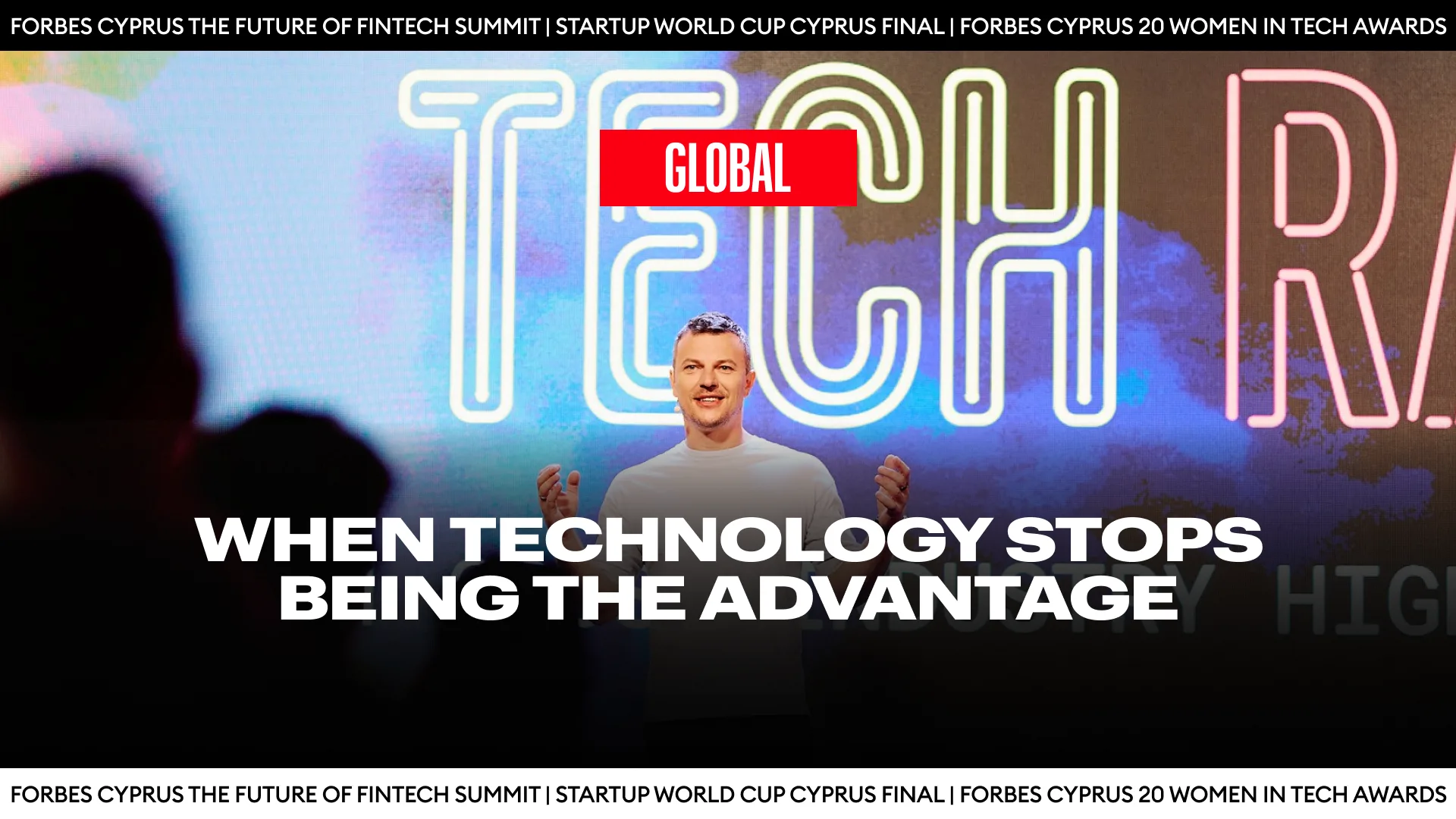
“The real tech race is not won by technology anymore,” SOFTSWISS founder Ivan Montik announced to an audience in Warsaw. “It’s won by the speed of decision-making and execution.”
Montik was opening the first Tech Race Summit, which brought around 1,500 technology professionals to the Polish capital on 10 September 2026. More than 40 speakers appeared across three tracks covering business strategy, engineering and emerging technology.
Follow THE FUTURE on LinkedIn, Facebook, Instagram, X and Telegram
Montik was speaking about management, but the same concern returned in later talks about product growth, infrastructure, workplace AI and team building. Technology remained central to every company represented on stage. However, the agreement was that AI allows more and more businesses to develop software, test ideas, and respond to competitors at greater speed. A technical advantage that once lasted years is now much easier for competitors to close.
Each speaker approached the problem differently. Some concentrated on reaching customers. Others examined what happens when AI leaves the demonstration stage and enters everyday business operations.
Decisions Have To Travel Through The Company
Montik said technology platforms once gave their owners a considerable head start. Today, it is a different story. Competitors are using the same AI tools to develop similar products and respond to changing customer expectations.
“Technology alone doesn’t create value. Decisions do,”
he said.
Fast decisions, Montik argued, should not depend on the chief executive being involved at every stage. Smaller teams need defined responsibilities and enough independence to act without repeatedly returning to senior management for approval.
He used SOFTSWISS’s entry into prediction markets as an example. Montik said consumer prediction-market platforms had boomed in 2025, but nobody was offering a comparable B2B product. SOFTSWISS decided to build one and took it from the initial decision to production in two and a half months.
He credited the quick turnaround to the way the project was run, particularly its small team, defined targets and individual ownership of decisions.
However, Montik did add one condition to his statement.
“Never sacrifice resilience for fast growth.”
Shazam Was Never Only An Algorithm
Dhiraj Mukherjee, co-founder of Shazam, told the story of a company that began before smartphones and app stores existed.
When Mukherjee and his co-founders considered building a service capable of identifying music through a mobile phone, he estimated its probability of success at around 4%.
“So I quit my job and became an entrepreneur,” he recalled, laughing. “Very stupid.”
The founders needed technology that did not yet exist in the market. They found it in the work of Avery Wang, the digital signal-processing specialist who became Shazam’s fourth co-founder and developed its music-recognition algorithm.
“The algorithm was the core of it, but the team grew and grew,”
Mukherjee said.
The company needed engineers to connect the service to mobile operators. It also discovered that no complete digital database of recorded music existed, forcing the team to build one. Employees digitised CDs, extracted their audio fingerprints and manually entered the song and artist information.
Then came the work of finding customers.
“It’s not just about algorithms. It’s not just about music. It’s about marketing as well. Otherwise, you have a product which no one has heard of,”
Mukherjee said.
Shazam came close to bankruptcy after the internet bubble burst and investment dried up. The company sold its music-recognition technology for use in monitoring songs played by radio stations, giving it enough income to survive.
The iPhone and App Store later gave Shazam the interface and distribution it had been missing. According to Mukherjee, it took ten years for the service to reach one billion uses. The next billion took a year, and the one after that took two months.
Shazam was eventually acquired by Apple in 2018 and has since been used more than 100 billion times.
By the time Shazam found a mass audience, its breakthrough algorithm was only part of the story. The company had built its own music catalogue and found a way to survive when venture funding dried up. The team then waited years for the consumer platform that would finally distribute the product to a much larger audience.
A Great Product Still Has To Reach Somebody
Mikita Mikado, co-founder and Chief Product Officer of PandaDoc, picked up the commercial side of Mukherjee’s story.
“A great product has never been enough to build a great business. You need money,”
he said.
AI may reduce the cost of creating software, but it is also increasing the number of products competing for attention. Mikado argued that conventional digital marketing has become more expensive while also producing weaker returns.
“Great products still need distribution,”
he explained.
PandaDoc’s approach was to make the product itself a means of attracting customers. Every document bearing the PandaDoc name gives another person direct exposure to the service.
“What works is products becoming marketing,”
Mikado said.
He expects that principle to extend to purchasing decisions made with the assistance of AI. Prospective customers already use chatbots to compare products, read reviews and examine pricing. Companies will therefore have to consider whether machines can understand and recommend what they sell.
“Word of mouth is still the king. It has been the king for consumers. It will be the king for machines,”
he said.
Mikado also placed considerable emphasis on partnerships. Smaller businesses can reach customers by embedding their products in the systems and marketplaces of larger companies. PandaDoc did just that in its earlier years by connecting its agreement software to established customer relationship management platforms.
That argument led to one of his five recommendations.
“Be the machine’s answer.”
Moving AI From Demo To Production
Georgios Chatzimilioudis, Principal Account Cloud Engineer at Oracle, centred his talk on the word required to move AI from the demo stage into production.
He began his presentation with a quick test.
Almost every hand went up when he asked who expected their business to use more AI within three years. The hands stayed raised when he asked whether those companies would use more than one model.
He then asked who knew which model, chip, or platform would matter most to their business in the next three years. The hands came down.
“That’s the problem. We’re called today to make architecture decisions, investment decisions, product decisions on things that we can’t see far ahead,”
Chatzimilioudis said.
His clients, he said, are now less concerned with choosing a model than with making AI work securely across their data and applications.
He said companies needed to take AI “beyond the demo, into production where real constraints come in.”
“It has to work within regulations, within budget and within security constraints,”
he said.
The commercial value of AI, he argued, is in its use.
“Training is great because this is where intelligence is manufactured. But value comes when the model is used,”
he said.
Adding the same readily available AI service to an existing system will not set companies apart because competitors can do the same, or will be able to very soon. Chatzimilioudis stated that a greater advantage comes from connecting AI to the data, processes, and specialist knowledge particular to a company.
Giving AI Enough Knowledge To Do The Work
Michael Tremante, Field CTO at Cloudflare, shared what this problem looks like inside a company of around 5,000 people.
Cloudflare initially gave its employees access to Gemini through the Google services already used across the company. Tremante described the result candidly.
“It worked, but it felt more like a tech demo than anything else,”
he said.
Employees could produce presentations and experiment with prompts, but the model had limited access to Cloudflare’s internal processes and tools. Engineers later adopted a more advanced coding interface, although many colleagues outside research and development continued to struggle with its configuration.
The company responded by developing an internal system called Cloudflare OS. It gives AI tools access to approved company information, connects them to business systems, and allows employees to build automated workflows in controlled environments.
“It’s not enough sometimes to just apply an LLM to an existing workflow or to an existing job. You really need to throw everything out of the window, very often start from scratch,”
he said.
He gave the example of a sales representative preparing for a customer meeting. An AI assistant might help assemble a presentation after receiving instructions. A more useful system would detect the meeting, research the company, check its account history and support requests, and prepare the material before the employee began work.
The employee could then spend less time preparing documents and more time “speaking to other people and applying higher-level reasoning”, Tremante said.
Cloudflare’s first attempt also created a different problem. Within weeks, employees had built around 100 dashboards performing similar functions. Tremante warned that such applications can be left without an owner when their creator leaves the company.
“Everyone building the same thing is the opposite of productivity,”
Tremante said.
He said applications created internally therefore need an owner and shared responsibility in the team, alongside restrictions on the information AI agents can access.
The People Building The Product
Javier Verdura, Tesla’s Global Director of Product Design, spoke about building high-performing product teams.
Based on his experience with Tesla’s Supercharger, Powerwall and Solar Roof, Verdura discussed team ownership and the relationship between design and engineering. His session also examined how rapid iteration and individual accountability affect the development of products inside large companies.
Technical excellence was still an integral ingredient in every example. Shazam began with a breakthrough algorithm. Oracle and Cloudflare showed how much engineering is required to make AI reliable inside a business.
What has changed is how quickly a technical lead can be copied, leaving businesses less time to turn it into a product that customers will use and pay for.
Mukherjee ended his talk by returning to what he called adaptive intelligence, the ability to keep learning while the job itself changes.
“It’s not about what you know,” he said. “It’s about what you learn as you do the job.”