

Kathy Kattashis had just hit her teens when her mother passed away from breast cancer. Her mother was 47 years old. What Kattashis was not aware of at the time was that her mother had gone through chemically induced menopause during her chemotherapy treatments. Her mother never spoke of it, nor did anyone else in the family. It was only when Kattashis was in her late 30s, going through premature menopause herself, that she began to understand, piece by piece, the full extent of the suffering the women in her family endured in silence. For the past several years, she has worked on her own and then through her registered non-profit to create an environment in Cyprus where women no longer have to face these changes alone or in shame.
Follow THE FUTURE on LinkedIn, Facebook, Instagram, X and Telegram
Kathy Kattashis is the founder and director of MITRA Cyprus Menopause Centre (Κέντρο Εμμηνόπαυσης Κύπρου), a Cyprus-based non-profit organisation focused on advancing menopause research, education, and advocacy across the island. She led Cyprus’s first national menopause survey and has worked with employers including Microsoft EMEA and the Central Bank of Cyprus to improve menopause awareness and workplace support. Through MITRA, Kattashis contributes to policy discussions on women’s health and has provided evidence and recommendations to national menopause legislation in Cyprus. She works to improve access to evidence-based information and support informed decision-making around menopause. Kattashis is also building Verity, an AI platform that translates peer-reviewed menopause research into clear, source-cited guidance for women, employers and the professionals who support them.
Kattashis grew up in what she describes as a non-traditional Cypriot family. Her mother had Irish roots and her father, though Cypriot, didn’t grow up on the island. They settled on the island after the 1974 invasion. Her mother was a businesswoman who ran a highly successful clothing company, designing and manufacturing clothing for plus-size women and exporting it internationally. Kattashis remembers her mother striding around the house with a Filofax rather than the apron worn by some of her friends’ mothers. Her mother had no time to conform to the housewife stereotype of the time. She was far too busy.
As a child, Kattashis did not think much about what it meant to be a woman. What she absorbed about womanhood, without consciously recognising it at the time, came largely through the lens of patriarchal culture. Duty, marriage, motherhood, all bound together. A woman had to find a man, marry, and have children. The local culture offered little space and even less encouragement for a woman to create something on her own. Her mother was the exception, which meant she was unprepared when those expectations hit her later in life. “It was probably very much like Eternal Sunshine of the Spotless Mind. Ignorance is bliss. I thought everything was OK. But it wasn’t.”
What has changed her thinking in recent years is a series of small realisations about how women’s lives are shaped. She gives the example of her grandmother, who married at the age of 15. Now, at 96, her grandmother has spent most of her life on her husband’s passport. She could not travel without him. “So the idea is we are the property of someone,” Kattashis says of the marriage system as she has come to see it. “It’s not a feminist thing to say. It’s not about anything that anyone’s benefiting from.” When discussing patriarchy, however, she is careful not to equate patriarchy with men. The system fails men too. “I have a son. So, for me, it’s difficult to see that my son is also in a system that will reinforce him not to be sensitive […] I’m not a feminist against men. Not at all. But I’m against the system.”
The idea for MITRA came from Kattashis’s own body. Even before she had her son, she had been experiencing irregular periods. She visited an endocrinologist and a gynaecologist who both told her if she wanted children, she needed to start now or freeze her eggs. The doctors mistook her concerns for questions about fertility rather than as symptoms of what was happening to her body. When she returned after giving birth to her son with the same concerns about sporadic periods, their interest had cooled. She had, after all, already had a child. Whether her periods continued was, apparently, no longer a priority.
But Kattashis pushed on in her search for answers. “I was looking for the information. I was begging doctors. I changed doctors because the others wouldn’t listen,” she says. After months of tests, she was finally given a diagnosis: premature menopause. On the one hand, the diagnosis explained the hot flashes, joint and muscle pain, rapid weight loss, and depression.
Yet, Kattashis was in her late thirties and had a small child relying on her. How had she never heard of this before? But most importantly, what was she going to do?
What she needed was a support group. Even just one other woman who had gone through or was going through something similar to talk to. She left her name and phone number at multiple clinics. Nobody ever called. She started a Facebook page where she posted about how she was feeling. It got some traction. She reached out to menopause organisations in the UK and found women there willing to talk to her. But back home, she still felt isolated.
Then one day she found an article mentioning that Cypriot MPs were going to hold a session on menopause in parliament. She immediately reached out and asked to speak during the session. The response to her request was polite but confused.
“Who are you?” she was asked.
“I have a Facebook page,” she replied.
“No, that’s not enough,” came the response. “People will laugh at you if you come as a person. You need an organisation behind you.”
Soon after, Kattashis registered MITRA as a non-profit organisation. “A bit out of spite,” she laughs. Finally, she was invited to speak at a public consultation on access to non-hormonal treatments for menopause on GeSy, Cyprus’s national health system. She immediately agreed, naively. She had not even read the full position statement email before attending and was caught unawares of how the event unfolded. What she remembers most vividly about the consultation was how packed the room had been for the previous item on the agenda. As soon as the session ended, the crowd took their leave.
“Everyone seemed to have left the room as soon as it was a woman’s health issue,” she says. “There was a huge contrast between how full it was before and how empty it was after. And the silence.”
This has been one of many difficult lessons Kattashis has had to learn along the way. Almost every gynaecologist, doctor, therapist, and pharmacist association that received MITRA’s pitch failed to respond. The Cyprus-based professionals she invited to join MITRA’s medical board declined. Women’s groups have treated her with caution. Some medical professionals have even called her ‘too pushy,’ especially in her outspokenness about changing doctors when patients, especially women, feel they are not being heard. “I know I can be seen as someone difficult,” she says, with a laugh. “I am difficult.”
What actually exists in the Cypriot healthcare system, as things stand, is less than most women assume. Menopause hormone therapy is free through GeSy, but the options are very narrow. There are two forms available, oral and transdermal, and the transdermal patch comes in only one dose, 50 micrograms, even though other countries offer it in 25, 50, 75, and 100 to cater to different needs. Women in Cyprus, therefore, resort to cutting the patches or wearing multiple patches at once. Only two doctors specialise in ageing women and menopause, both private and not covered under GeSy. Kattashis argues that Cyprus needs to train or retrain doctors on menopause. The government also needs to reallocate its funding to women’s health. “Unless something changes in the way the government is budgeting things, I’m having a hard time seeing how it could happen.”
Sometimes, she feels as though she is fighting a losing battle.
“I’m working downstream with Mitra. I’m trying to close holes in a hole-ridden bucket, and the water just keeps coming out,”
Kathy says.
She has funded much of MITRA’s research from her own pocket against a system that has, so far, mostly ignored her. But she continues to knock on doors because she has decided the cost of doing nothing is higher than the cost of being difficult.
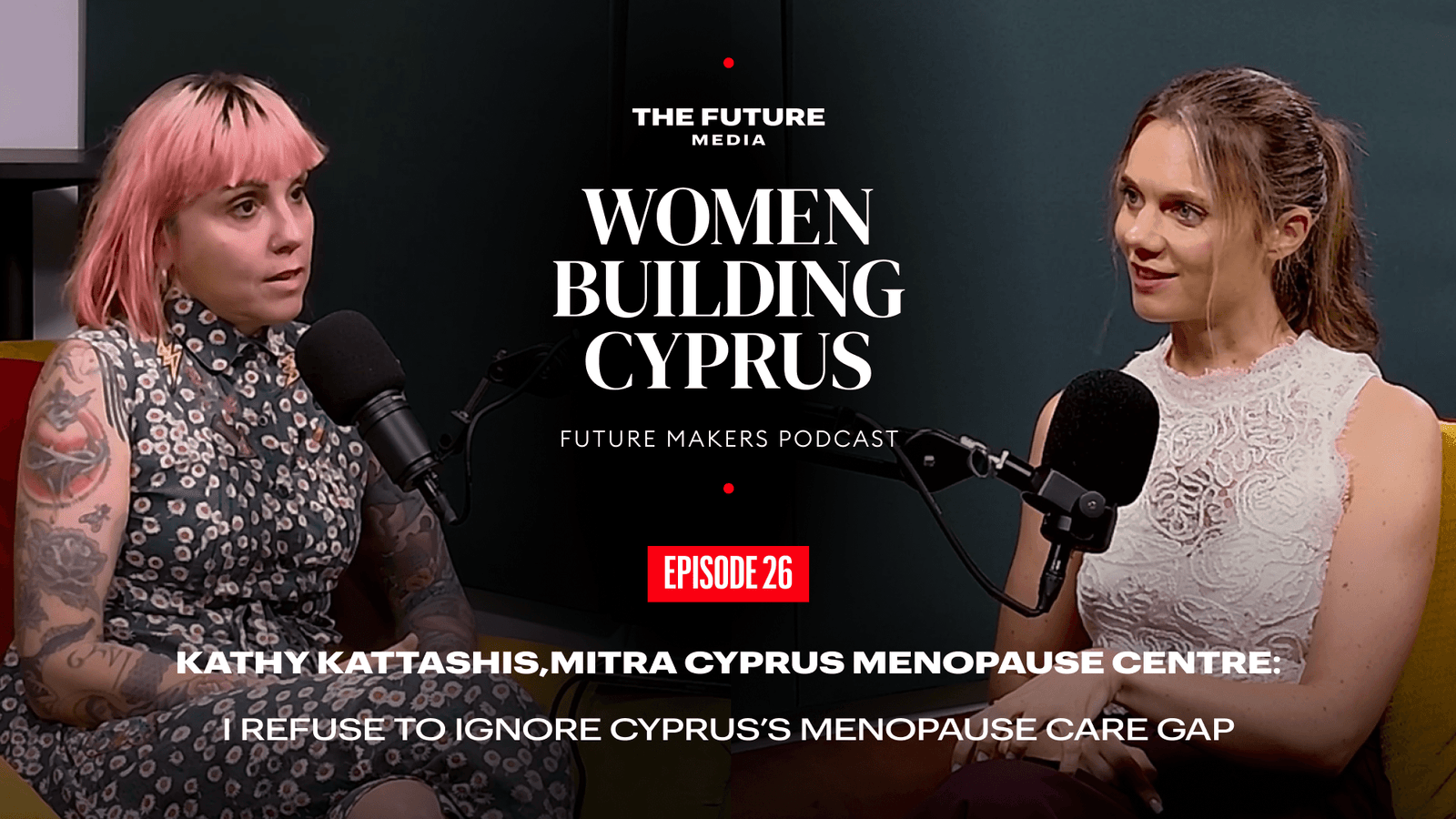
Kathy Kattashis is a guest on The Future Makers: Women Building Cyprus. The full episode, including her reflections on gaps in the Cypriot healthcare system’s care for women, why she refuses pharmaceutical funding, and what she wants gender budgeting to look like in Cyprus, is available to watch now.
The Future Makers Podcast is a series of in-depth conversations about how future-makers are made, in Cyprus and beyond. Host Annetta Benzar sits down with people who are a leading force in our shared future and looks past the titles. Together, they travel back to the people and moments that shaped them, walk through the choices and challenges they are living through now, and look ahead to the futures they are trying to build.
A production of The Future Media.