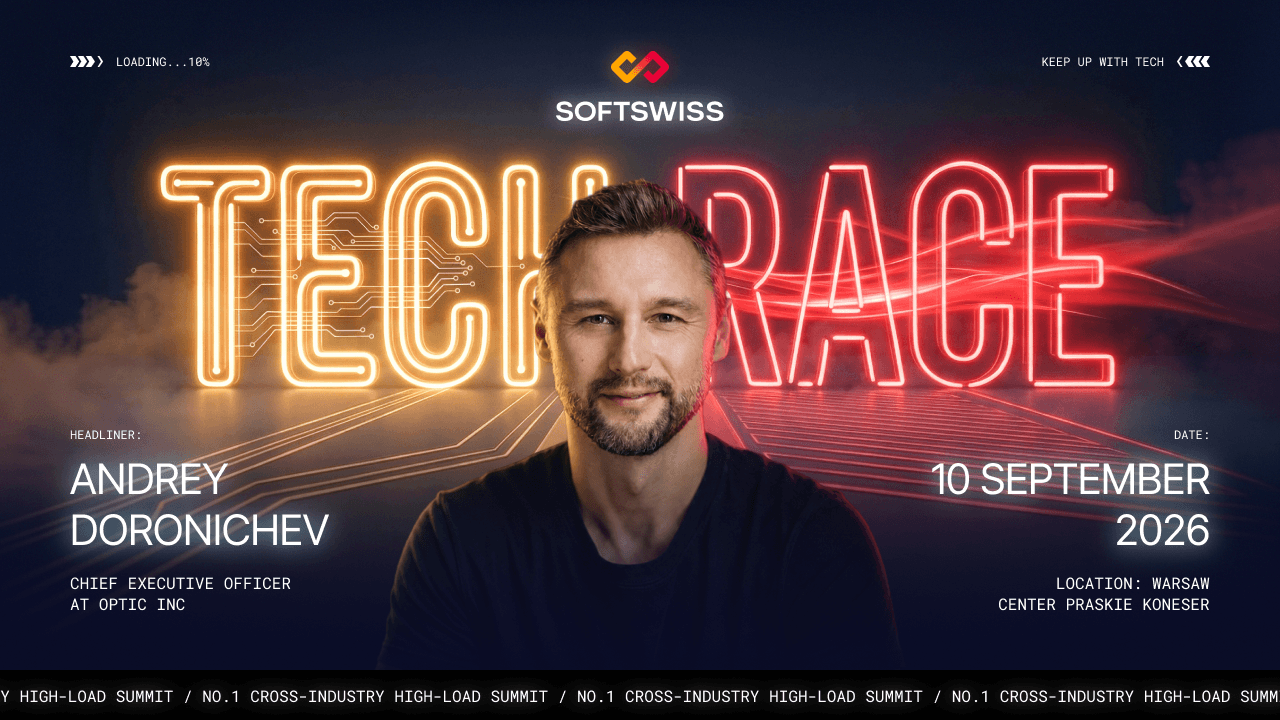
Tech Race Summit, organised by SOFTSWISS, will take place in Warsaw on 10 September 2026 at Centrum Praskie Koneser, Plac Konesera 8. The event will bring together more than 30 international speakers and 1,000 attendees for what the organiser describes as “the first cross-industry forum to exchange ideas, technologies, and expertise, driving the future of large-scale digital products.”
Follow THE FUTURE on LinkedIn, Facebook, Instagram, X and Telegram
The summit gathers engineers, technology executives, infrastructure specialists, and product teams to discuss how companies respond to growing technical complexity, cybersecurity challenges, and the rapid adoption of AI across business operations and consumer products. Speakers and contributors have been confirmed from big-name companies including AWS, Oracle, Cloudflare, Google, Fastly, Tesla, PandaDoc, Shazam, Gcore, ScyllaDB, and others.
The Keynote Line-up
Andrey Doronichev, founder and CEO of Optic and former Google executive, will deliver a keynote on how AI is changing industries and work. Doronichev spent 14 years at Google, where he helped develop products used by billions of people worldwide.
Javier Verdura, Global Director of Product Design at Tesla, will present “Building High-Performance Teams: Lessons from Tesla.” His session will explore how a globally recognised technology company builds teams capable of delivering products at speed while maintaining quality and innovation.
Mikita Mikado, co-founder and Chief Product Officer of PandaDoc, will deliver “Building the Next Silicon Valley Businesses.” PandaDoc is an agreement-management company that reached a valuation of $1 billion in 2021. In his keynote, Mikado will share lessons from scaling PandaDoc into a global software company.
They are joined by Dhiraj Mukherjee, co-founder of Shazam, and Artur Bergman, founder and CTO of Fastly, whose sessions will address technology shifts and the future of internet infrastructure. Ivan Montik, founder of SOFTSWISS, is scheduled to open the summit.
Cross-Industry Forum For High-Load Businesses
As online gaming businesses grow across regulated markets, they face many of the same questions as global technology companies, especially how to build high-performing teams, develop products at scale, and compete for talent whilst maintaining speed of execution. By bringing together leaders who have been there, done that from Tesla, PandaDoc, Amazon Web Services (AWS), Oracle, Cloudflare, and other global technology companies, Tech Race Summit creates a forum where these experiences can be shared across industries.
The programme covers cloud architecture, artificial intelligence, cybersecurity, engineering leadership, observability, product development, and company building. All sessions are held in English.
Sergey Kastukevich, Chief Technology Officer at SOFTSWISS, describes the summit’s origin as follows:
“Tech Race Summit was created to bring together people solving difficult technology problems and to explore what the future of technology holds.”
Kastukevich adds to the cross-industry framing:
“The technology challenges facing iGaming today extend well beyond infrastructure. Building successful technology companies also depends on leadership, product thinking, and the ability to scale teams as the business grows […] Our goal is to give attendees practical insights they can apply to their own organisations, regardless of the industry they work in.”
Three-Track Programme
The summit runs across three parallel conference stages. The Vision Track features keynotes and discussions about AI, infrastructure, cybersecurity, and technology strategy. The Solution Track focuses on technical sessions and case studies from engineers and architects working on modern digital systems. The Experiment Track covers technical deep-dives, implementation lessons, and engineering practices.
Attendance And Registration
The offline event is sold out. Online streaming tickets remain available through the event website. Sponsorship information is also available through the summit’s partnership page.
For more information and ticket details, follow the link here.
About SOFTSWISS
SOFTSWISS is an international technology company that has developed solutions for the iGaming industry since 2009. The company provides software for managing online gaming projects and supports more than 1,500 brands worldwide. SOFTSWISS’ product portfolio includes the Casino Platform, the Game Aggregator, the Sportsbook, and the Prediction Markets Platform. The company has more than 2,000 employees across its international locations, including Malta, Poland, and Georgia.



