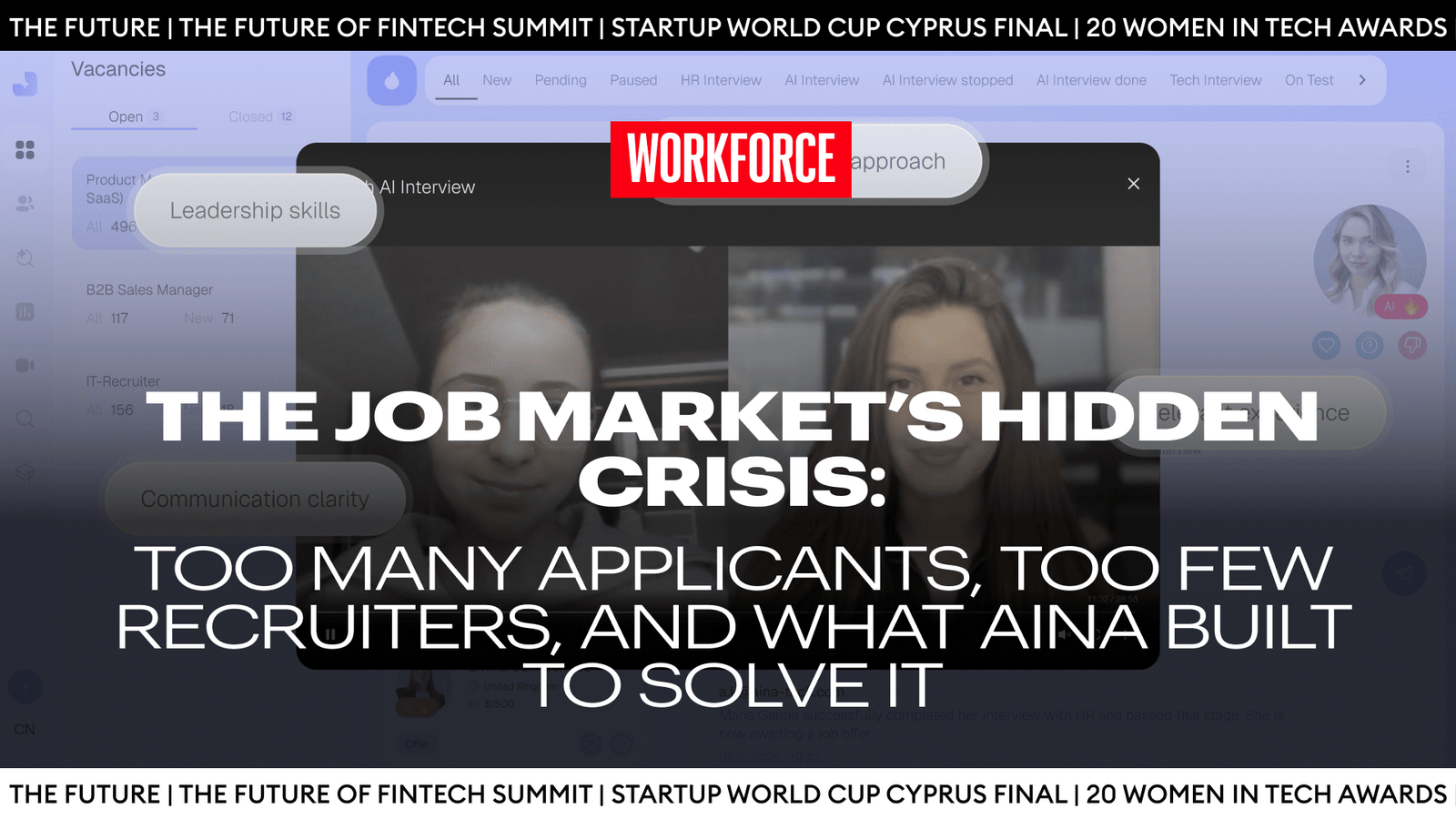
Recruiting teams are facing a capacity crisis. It’s no longer just about the difficulty of sourcing for the right candidate but also the operational load, process complexity, and the growing impossibility of keeping up. Recruiters now spend 38% of their time on interview scheduling alone, while application volumes grow exponentially and hiring cycles keep getting longer. The result is a system struggling to pull its own weight.
In its 2024 report, Greenhouse reported that recruiters received an average of 588 applications per role, up 26% year-on-year, while recruiting resources have stagnated. At the same time, 60% of organisations saw a time-to-hire increase in 2025, and only one in nine reduced it. Median global time-to-hire averages at 38 days. For technology roles, this number can reach 48 days, 26% slower than the global median.
Follow THE FUTURE on LinkedIn, Facebook, Instagram, X and Telegram
This not only affects the companies hiring but also the candidates. 40% of U.S. job seekers admit they expected the entire hiring process to take less than 30 days, significantly lower than the reported averages, creating a widening “speed gap” between what employers deliver and what the market demands.
Added to the recruitment tensions, operational pressure is also mounting. 45% of talent acquisition leaders report an increase in required hiring touchpoints, making recruitment more “high-touch” and harder to execute, while 93% of U.S. hiring managers say the hiring process took longer in 2025 than it did two years earlier.
With the advent of AI-generated applications, contributing to what Greenhouse’s CEO describes as an “AI doom loop,” where jobseekers use AI to apply to more jobs and employers use AI to filter candidates back out again, the system is seriously struggling. 91% of recruiters say they spotted candidate deception, and 34% spend up to half their week filtering spam and junk applications.
AINA was created as a direct response to this crisis. It was built as an empathetic AI hiring platform, with the promise to automate 80% of the recruitment process, removing operational bottlenecks while preserving human judgment. The goal is to give recruiters back their time, accelerate hiring cycles, and allow teams to focus on strategic, high-impact work rather than administrative overload.

In this interview with The Future Media, AINA’s CEO, Natallia Mikhnavets, explains how AI-driven automation can restore sanity to the hiring process and what it means for companies struggling to scale their teams in today’s talent market.
1. Before we discuss AINA, let’s start with you. What first drew you to the worlds of HR and technology?
I was drawn to HR because I genuinely like helping people find work that fits them, especially when that is a role they’re passionate about and can see themselves growing in. Early on, I saw how much impact hiring has on a company. The people you bring into a team largely determine where that company will be a year later. A strong team is the most important asset any business has.
Technology became interesting to me as a way to enhance the recruitment process by making hiring more objective, faster, and less dependent on human exhaustion. I started automating processes simply to survive the workload, and then realised there was a much bigger opportunity.
2. Looking back, what experiences (or frustrations) most influenced how you think about hiring and talent today?
Over more than a decade of hiring, leading, and scaling IT and product teams, I repeatedly saw how stressful, inefficient, and fragmented recruitment had become. Hiring slowed companies down, burned out recruiters, and pulled leaders into operational work that distracted them from actually growing the business.
I began experimenting with automation as a way to remove friction. At my previous workplace, Panoramik Games, I redesigned workflows across HR, finance, legal, and IT, replacing manual processes with data-driven systems. That work generated over $1M in cost savings and automated roughly 60% of service workflows. As a result, teams spent less time on administration and more time on creative, high-value work, resulting in an overall efficiency increase of more than 30%.
I felt data-driven hiring could also save companies millions of dollars, and make both recruiters and candidates satisfied with the process.
3. From your perspective, what are the biggest pain points in hiring today for both employers and candidates?
Hiring today is caught in a feedback loop of automation that often works against both sides. Companies are flooded with AI-generated applications that are poorly matched to roles, while recruiters increasingly rely on AI to write job descriptions, screen candidates, and even conduct chatbot interviews.
With roughly500 applicants competing for the attention of a single recruiter, many qualified candidates never reach a human conversation. This makes hiring slower, riskier, and more expensive, as a single bad hire can cost up to 30% of an employee’s first-year salary once recruiting, onboarding, lost productivity, and re-hiring are factored in.
Candidates feel the strain as well. Many, especially Gen Z, turn to tools like ChatGPT for career guidance. I’ve seen it personally, so it is no surprise to me that42% report using AI to plan their careers, yet still struggle to navigate opaque, impersonal processes.
We also have problems on the other end of the table. Recruiters spend hours on administrative tasks, candidates disengage due to slow communication, and companies lose revenue as roles remain unfilled. Stats back this up. Over 63% of HR leaders cite fragmented, manual workflows as the main barrier to hiring speed and performance, while 40% of recruiters worry that increased AI use is making hiring feel less human.
4. When did you realise this problem was big enough to build a company around, and what was the “aha moment” behind AINA?
The idea for AINA crystallised during a period of rapid growth. One of the founders I was working with turned to me and said, “If we could hire another you, our hiring problems would be solved.” That comment stayed with me. It captured something I had already been seeing time and time again. Companies weren’t constrained by access to talent, but by the limited capacity of recruiters to process large numbers of candidates. They needed technology to help them.
That was the “aha” moment.
The real challenge, though, was scalability. How could we replicate the structure, clarity, and decision logic of a strong recruiter without burning people out? AINA started as a way to solve exactly that.
5. For someone hearing about AINA for the first time, how would you describe what the company does and its main mission?
AINA is an empathetic AI hiring platform that accelerates business growth and reduces hiring costs by automating 80% of the recruitment process, allowing companies to hire better candidates faster.
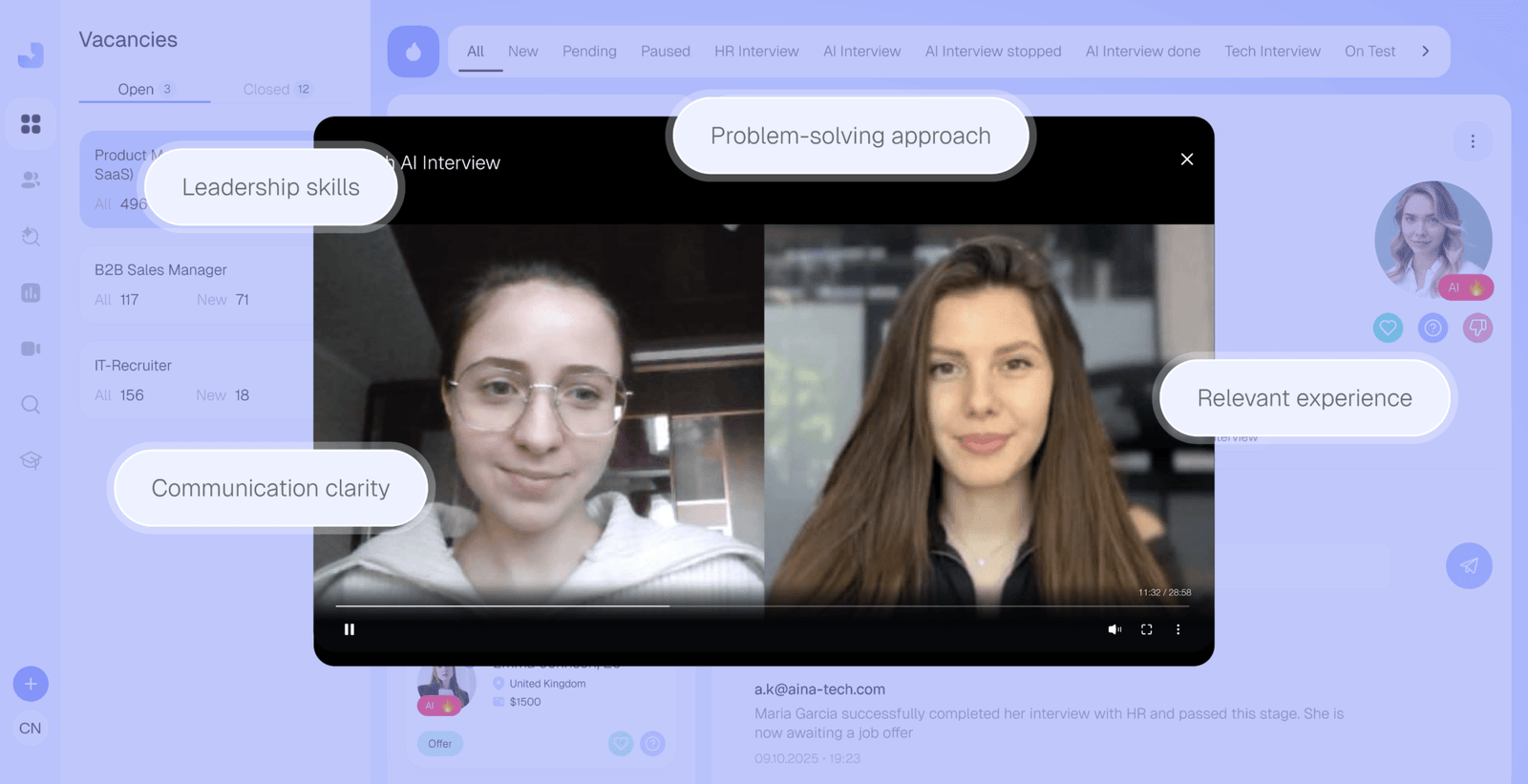
At its core, AINA addresses one of the biggest constraints on scaling: slow, manual hiring. By removing operational bottlenecks while preserving human judgment and empathy, we give companies back time, increase transparency, and allow recruiters to focus on strategic, high-impact work rather than repetitive tasks.
6. Can you walk us through how AINA works end-to-end and where humans stay in control?
AINA is designed to support recruiters throughout the early stages of hiring. The platform handles time-intensive tasks such as candidate screening and early technical assessments, helping recruiters swiftly identify the strongest matches. Throughout the process, AINA adapts dynamically to candidate responses rather than relying on rigid templates.
Crucially, human recruiters remain in control at every decision point. AINA acts as a collaborative AI teammate, increasing speed, consistency, and clarity, while final evaluations, interviews, and hiring decisions are always made by people.
If you look at our platform, our process is very streamlined and intuitive, and while AI provides very valuable data and irons out a lot of potential hiccups, humans remain at the helm. Yes, our AI interviewer conducts dynamic conversations, but all to help human recruiters make better decisions faster.
7. What makes AINA different from other recruitment platforms and AI hiring tools on the market?
What sets AINA apart is that it operates as an integrated hiring ecosystem instead of a point solution, and it is designed to serve both businesses and candidates.
We not only optimise for speed or volume, but also focus on improving decision quality, recruiter capacity, and candidate experience simultaneously.
8. What feedback have you received from users (hiring teams and candidates), and what have you changed in the product because of it?
I’m proud to say that the feedback we have received from hiring teams is that positions closed through AINA have had zero hiring errors so far. For recruiters and founders, that kind of feedback matters more than any feature list. It means the system is helping them make better decisions under pressure.
At the same time, we have learned a lot from candidates. One clear insight was that many people struggle with interview preparation. As a result, we launched a candidate interview trainer where candidates can practice, talk to our AI recruiter, and improve how they present their skills and thinking.
We’re also constantly refining our AI recruiter itself, making conversations more engaging, natural, and informative. The goal is to generate clear, actionable data for recruiters immediately after the interview, so they can evaluate candidates with confidence and context.
9. How do you measure success, and what results have you seen so far?
I look at whether teams are actually hiring faster, with less stress, and whether recruiters feel like they’ve regained control of their time. Also, I evaluate whether founders can see their teams growing faster.
So far, we’ve run over 2,000 interviews on the platform and helped companies close more than 300 roles. What’s been most striking is the speed at which this happens. We have seen highly specialised tech roles filled in hours or days rather than weeks.
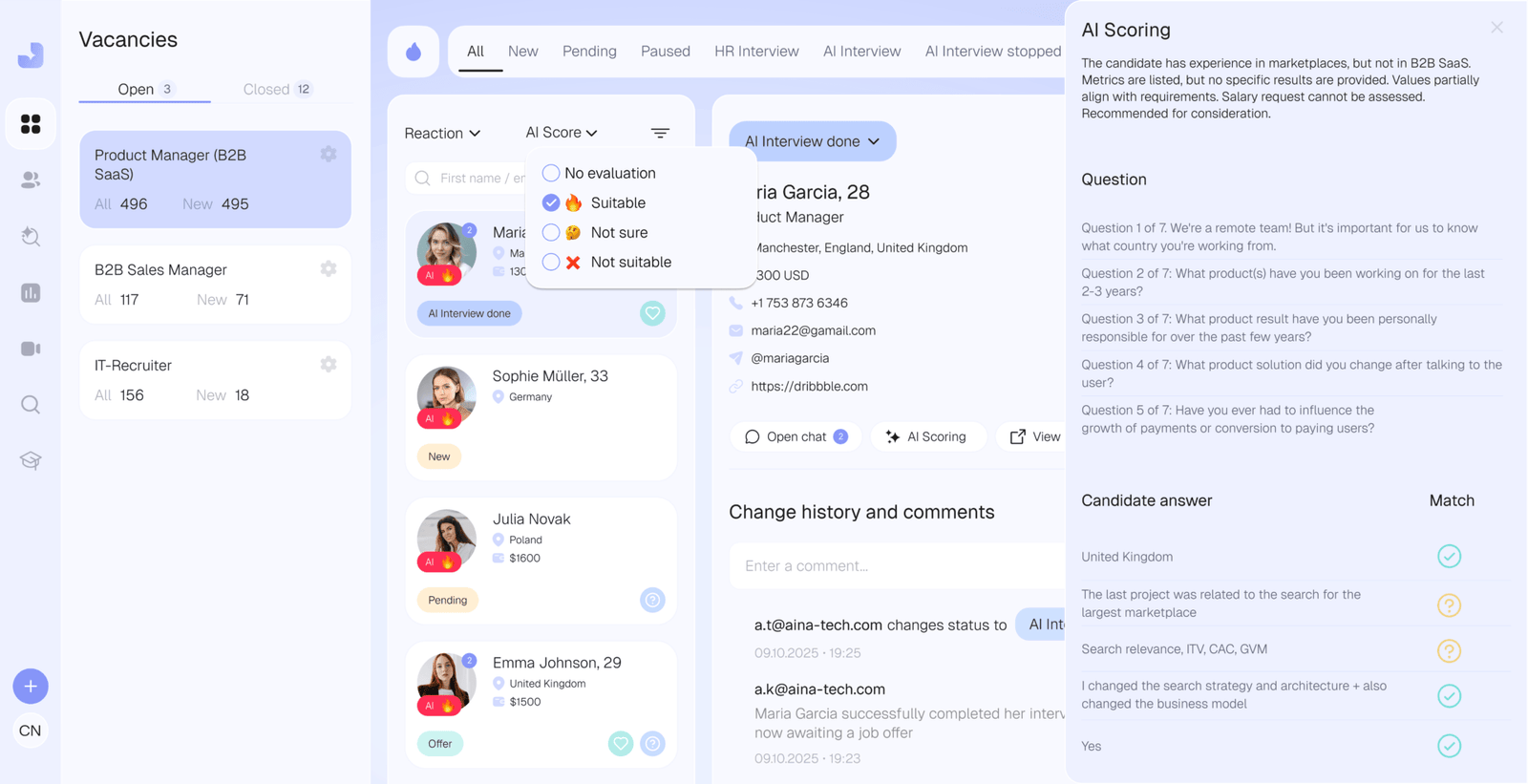
For instance, we had a Senior Java Developer hired in two hours, a Tech Artist in two days, a Project Manager in three hours, and a User Acquisition Lead in three hours.
I also pay close attention to referrals. About 40% of our new clients come through word of mouth, which tells me teams aren’t just testing AINA, but they’re getting real value from it.
10. AINA has secured seed funding. What did this milestone validate for you, and what will the funding allow you to do next?
Raising the seed round confirmed that the problem we’re working on is something the market recognises immediately, rather than a niche. This, in turn, also proves that there is a big demand for a solution like ours. The tech industry is highly competitive, and finding the right talent now is more important than ever to survive the competition and generate revenue.
The funding allows us to keep growing the platform: improving our AI-driven recruiting workflows, strengthening screening and analytics, and expanding candidate coaching. It gives us the space to keep refining the product without rushing compromises, so we can scale without compromising quality.
11. Bias, privacy, and transparency are major concerns in recruitment tech. What principles guide you here, and what safeguards do you have in place?
One of AINA’s core principles is ethical, non-biased decision-making. The AI evaluates candidates based on what they actually say, in real time, using the depth of a senior technical recruiter, but without personal assumptions or snap judgments. Instead, it adapts to each conversation, which allows for more consistent and transparent evaluations.
AINA supports decision-making by providing data-driven insights. Final judgments, accountability, and responsibility remain in the hands of the people, and that balance is essential for trust.
12. Building from a smaller hub like Cyprus, what advantages and challenges have you faced?
Cyprus is packed with talent, and the local tech community here is very supportive. For AINA’s team, and for me, it’s the perfect place to build, network, and grow our product.
13. What are your plans for the next five years?
Our focus is to prepare for the next investment round that will help us expand into GCC markets. Beyond geography, the bigger goal is to keep scaling the platform in a way that stays true to why we built it in the first place, making hiring faster and more efficient without stripping out the human side of the process.
14. What is one piece of advice you would give to other founders building global companies from smaller hubs?
Be brave in your decisions and don’t dilute your vision just because you’re building from a smaller hub. Strong companies aren’t defined by geography — they’re defined by clarity of thinking and execution.
Investors don’t back locations, they back founders who see a real problem clearly and are willing to move fast to solve it. If your product creates real value, borders matter far less than people think.
Build globally from day one, talk to customers everywhere, and don’t wait for permission. The world is genuinely open, but only if you act like it is.