


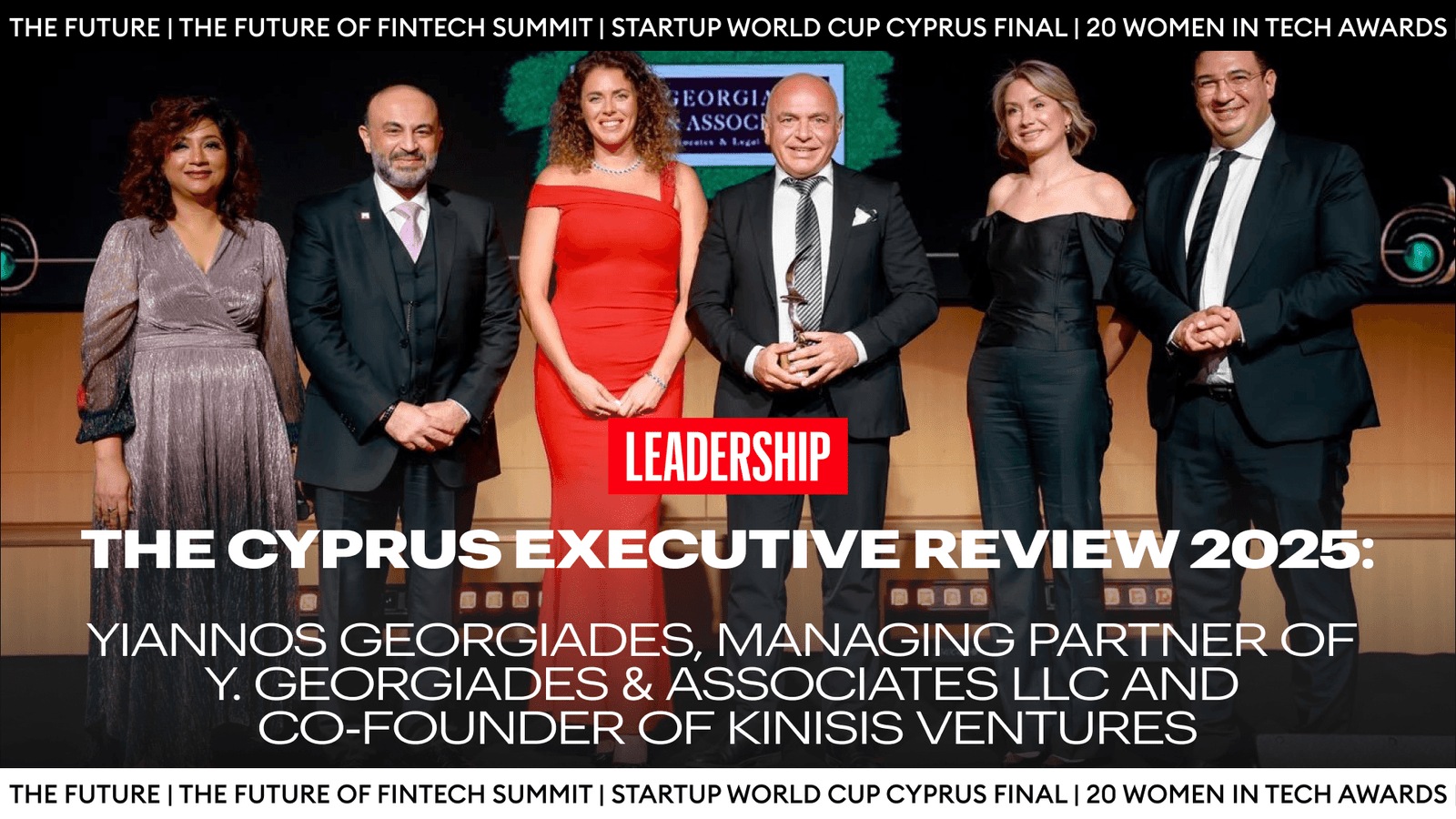
The Cyprus Executive Review: 2025 is a new interview series that invites top business and technology leaders to reflect on the defining moments of the year, the difficult decisions that shaped the direction of their organisations, and what they are taking into 2026.
In this interview, we speak with Yiannos Georgiades, Managing Partner of Y. Georgiades & Associates LLC, Cyprus’s only law firm to be named “Law Firm of the Year – Cyprus” two years consecutively, and co-founder of Kinisis Ventures, a regulated VC fund backing early-stage tech companies with a clear pathway to the U.S. market.
Follow THE FUTURE on LinkedIn, Facebook, Instagram, X and Telegram
Yiannos Georgiades’ 2025 was defined by convergence: the deliberate integration of legal strategy, venture capital, and cross-border expansion into the Gulf, all while advancing AI governance, global professional networks, and leadership in dispute resolution.
What follows is his reflection on building a unique model that integrates legal strategy and venture execution, one where legal excellence doesn’t just advise on innovation, but actively fuels it.
1. What was the turning point moment of 2025 for you and/or your organisation?
The turning point for our organisation in 2025 was deciding to expand into the MENA region, starting with the UAE and Saudi Arabia. For Y. Georgiades & Associates LLC, a firm with 34 years of continuous practice, it was a natural next step after consecutive “Law Firm of the Year – Cyprus” wins and a steadily growing international mandate base. The expansion brought us closer to clients, capital, and the innovation ecosystems shaping the next decade.
It also strengthened the integrated platform we’ve been building between law, investment, and cross-border growth. Alongside our legal practice, I co-founded Kinisis Ventures, a regulated venture capital fund focused on innovation and technology. Y. Georgiades & Associates LLC acts as the external legal advisor to the fund, and I also serve as a member of the Investment Committee. This gives us a rare end-to-end understanding of how ambitious companies are structured, financed, and scaled, especially into the US market.
The year also included an exciting diplomatic dimension. I was appointed General Secretary and Permanent Representative of the Consulate of Ethiopia in Cyprus, which is hosted within our law firm’s premises. This further strengthened our practical connectivity and cross-border collaboration.
2. What were your two biggest wins in 2025
First, Y. Georgiades & Associates was named “Law Firm of the Year – Cyprus” for the second consecutive year at the Legal Era Middle East Law Awards in Dubai. It’s a prestigious international platform that brings together leading firms from across the region and beyond, with global names such as DLA Piper, Clyde & Co, Baker McKenzie, Al Tamimi, and Bird & Bird recognised across categories. Winning twice in a row was an honour for us because it reflects not just the value of our results, but also the way we operate. We are innovation-led, technology-enabled, and built for complex international work. The award was also supported by high-impact successes, including matters before the European Court of Human Rights and the European Patent Office Board of Appeal.
Our second major win was Kinisis Ventures reaching a major milestone with Fund II, completing its first close in 2025 and beginning active deployment. Fund I reported strong indicators: 127% total growth in value since launch (based on funding round valuations), a 100% up-round track record, €15 million co-invested, and 60% of portfolio companies with commercial activity in the U.S. Fund II follows the same approach: €300K–€500K initial tickets at pre-seed and seed, paired with hands-on support to help founders build real commercial momentum in the United States.
I would further like to highlight our professional collaboration through GLAWBUS, the Brussels-based global network of lawyers and other professionals. In my capacity as President, I co-organised, together with our GLAWBUS member AMBS Law Firm in Portugal, the GLAWBUS Congress in Lisbon, bringing together lawyers, other professionals, and scientists from around the world to explore emerging trends, including AI, genomics, and the law.
3. What was the hardest decision you made in 2025?
The hardest decision was committing to scale on multiple fronts at the same time. This included expanding into the Gulf while managing demanding cross-border matters, and simultaneously building broader platforms across venture, professional networks, and dispute resolution leadership.
The reality is that our models are high-touch. On the legal side, complex international mandates require depth and focus. On the venture side, meaningful support to founders takes time and attention. The decision came down to disciplined prioritisation, and a clear view that these initiatives reinforce each other rather than compete.
4. What single metric best captures your 2025 performance (and why that one)?
For me, it’s convergence. What I mean by that is being recognised at the highest level in legal services while simultaneously delivering measurable outcomes in venture investing.
In 2025, we secured a second consecutive Law Firm of the Year award while Kinisis Ventures Fund I reported 127% portfolio value growth since launch (based on funding round valuations), a 100% up-round track record, and 60% U.S. commercial activity across the portfolio. It demonstrates that combining legal strategy with investment execution creates a multiplier effect for clients, founders, and investors.
5. What changed most in your industry in 2025, and what didn’t change (but should have)?
The biggest change was the acceleration of AI adoption, and the realisation that modern legal practice must include technology fluency, governance, and risk design. We embedded AI-enabled workflows across contract work, compliance, and research, under professional controls that protect confidentiality and quality.
In parallel, I’ve focused on thought leadership around AI governance and legal risk, sharing practical frameworks at international engagements across Europe, the MENA region, Singapore, and Malaysia. The central message is this: AI won’t replace professionals, but professionals who use AI clearly, lawfully, and intelligently will outpace those who don’t.
2025 also reinforced the value of global professional ecosystems. I was appointed a member of the newly formed International Council of the Global Legal Association (GLA), supporting international collaboration and standards across the profession.
What hasn’t changed—but should—is the [legal] profession’s too-separated relationship with entrepreneurship and innovation. Too many firms stay in a narrow advisory lane instead of operating close to builders and investors. Our experience is that legal excellence and entrepreneurial execution don’t compete. Together, they produce better, faster, more commercial outcomes for clients.
6. How did AI or automation change your execution in 2025?
AI improved both quality and speed when implemented with governance and clear professional oversight.
Across our legal practice, AI-enabled tools strengthened contract analysis, compliance workflows, and research, particularly in a multi-jurisdictional environment. In complex matters, we were able to reach faster identification of relevant authorities, clearer structuring of arguments, and more disciplined review of extensive materials.
We treated AI as a multiplier of professional judgment, not a shortcut. The objective was to deliver better outcomes with consistency, confidentiality, and accountability.
7. Give us your two predictions for 2026, one for your industry and one for the wider business/tech ecosystem.
For the legal industry, 2026 will accelerate the rise of the lawyer-entrepreneur—professionals who combine legal excellence with business fluency and cross-border execution. AI will keep raising the baseline, and the winners will be those who deliver faster, safer, more strategic outcomes while understanding how founders and investors actually operate.
Dispute resolution will be central to that shift. In my capacity as President of the European Court of Arbitration & Mediation on Commercial Disputes (Cyprus Chapter), I see growing demand for faster, more specialised, more tech-aware frameworks, without sacrificing enforceability or due process. That’s also why I’m participating as a panelist at the International Arbitration & Litigation Summit in Malaysia (22–23 January 2026), in the plenary session “Litigation & Arbitration 2030 – Shaping the Future.”
For the wider business and tech ecosystem, early-stage investing will move further toward an integrated capital-and-capability model. Founders need more than funding: they need regulatory clarity, governance, US-market support, and global networks. Funds and platforms that combine capital with real execution support, without creating dependency, will become the preferred partners.
8. What was your word for 2025, and what word are you taking with you into 2026?
2025: Excellence. Because we refused to trade standards for growth. We expanded, won, invested, and delivered outcomes across legal and venture, while maintaining quality.
2026: Scale. The model is proven. Now it’s about extending its reach. Scaling our MENA footprint, Fund II deployment, AI-enabled capability responsibly across jurisdictions, and our impact in AI governance, innovation, and dispute resolution.