Breaking news

Doers Summit Expands To Dubai, Connecting Global Ecosystems

The Doers Company and Dubai Integrated Economic Zones Authority (DIEZ) have signed a strategic agreement to host the first Middle East edition of Doers Summit at Dubai Silicon Oasis in November 2025, connecting Europe, the Middle East, South Asia, and beyond.
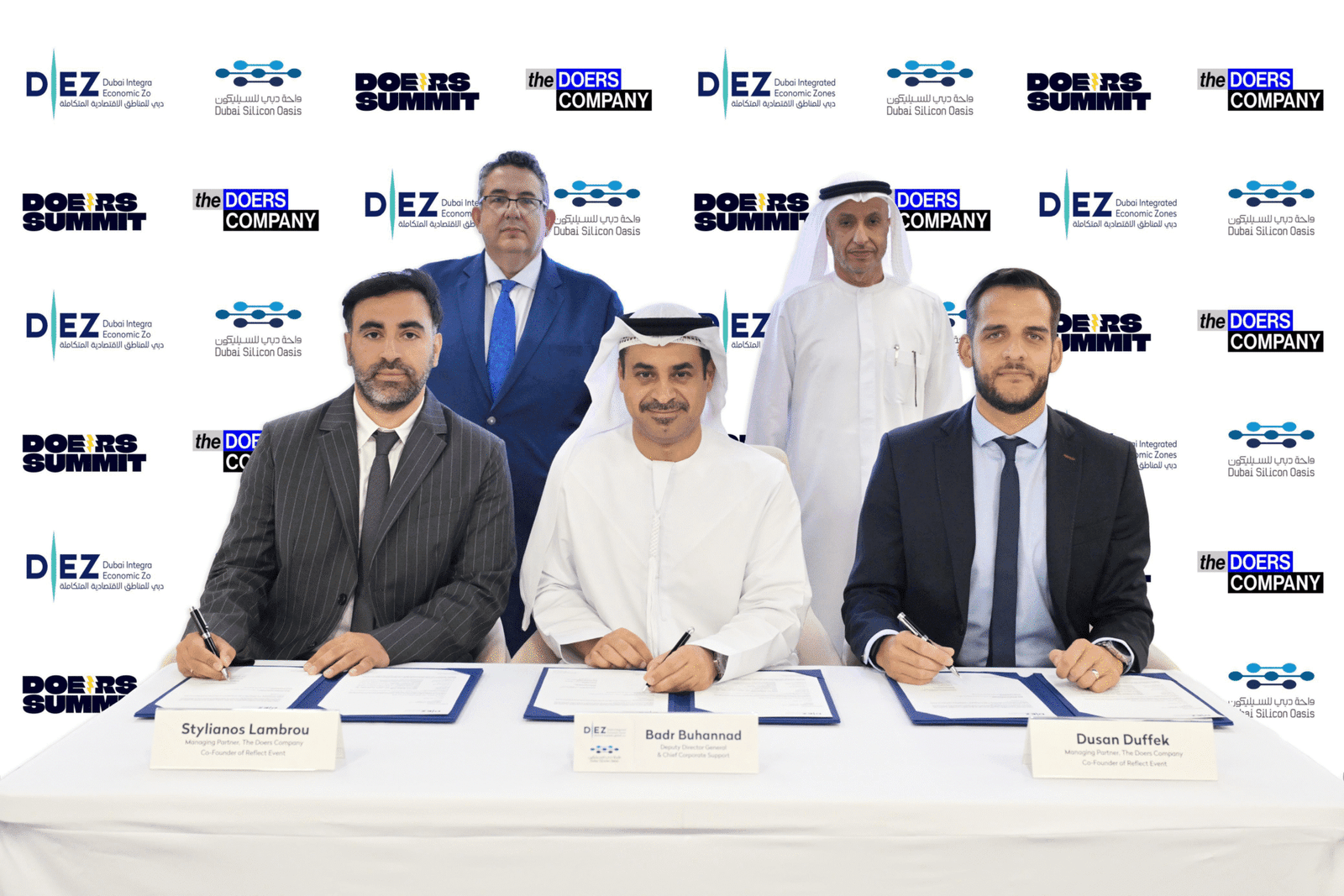
Doers Summit Expands To Dubai, Connecting Global Ecosystems

A signing ceremony was held in Dubai, attended by His Excellency Dr. Mohammed Al Zarooni, Executive Chairman of DIEZ, and Demetris Skourides, Chief Scientist for Research, Innovation & Technology at the Government of the Republic of Cyprus, underscoring government-level support for cross-border entrepreneurship and innovation.

“Hosting this renowned Summit with The Doers Company aligns with Dubai’s Economic Agenda D33 and our commitment to positioning Dubai as a global leader in economic and digital growth,” said Badr Buhannad, Deputy Director General of Dubai Silicon Oasis.

The Dubai edition aims to bring together over 3,000 participants, including startups, venture capital funds, and ecosystem leaders, catalysing cross-border collaboration and capital access while maintaining the Doers Summit’s experience-led format of high-impact networking, curated content, and actionable deal-making.

Reflect Festival Becomes Doers Summit: A Unified Vision for Global Doers

This expansion to Dubai comes at a pivotal moment for The Doers Company, as it unifies all its flagship events under a single global brand.

Since its inception in 2018, Reflect Festival has grown from a local gathering in Limassol into one of Europe’s leading technology and entrepreneurship events, welcoming over 50,000 founders, investors, and operators across Limassol, Athens, and city meetups throughout Europe. Now, Reflect Festival evolves into Doers Summit, aligning a vision to create a single, global gathering of doers that fosters meaningful connections and builds ecosystems where it matters most.

“Reflect Festival was close to many of us, but evolving it into Doers Summit was about clarity of purpose,” says Stylianos Lambrou, Co-founder and CEO of The Doers Company. “Now, we are building a global gathering that creates the partnerships and opportunities shaping what’s next.”

The move to Dubai marks a natural progression, connecting Europe, the Middle East, South Asia, and beyond while maintaining the experience-led approach that defines Doers Summit: curated content, high-impact networking, and real-world deal-making.

“This is more than scaling an event, it’s scaling a movement,” adds Dusan Duffek, Co-founder and Managing Partner at The Doers Company. “We’re creating moments of convergence where regions connect, ideas collide, and real deals happen.”

With Dubai, Athens, and Limassol now under the unified Doers Summit banner, The Doers Company is laying the groundwork for a truly global ecosystem where doers can continue to learn, connect, and build what’s next, together.

Assessing The Divergent Energy Futures: The European Union Versus Cyprus

European Electricity Transition: A Bold New Horizon

A recent report, European Electricity Review 2026, published by Think Tank Ember, highlights a stark disparity between the energy strategies of the European Union and Cyprus. While the EU is rapidly advancing its renewable energy agenda, underpinned by an aggressive shift away from fossil fuels, Cyprus remains reliant on an increasingly costly and pollutant electricity system dominated by conventional fossil fuel sources.

European Union Electricity Mix 2025

The EU’s electricity landscape continues to shift toward renewables at a notable pace. Wind and solar energy now play a central role in the bloc’s power generation, gradually overtaking fossil fuels.

According to projections for 2025, wind contributes 16.9% of electricity production and solar 13.2%, bringing their combined share to 30.1%, slightly ahead of fossil fuels at 29%. Hydropower remains significant at 17.6%, although drought conditions have constrained its output in several regions. In total, renewable sources account for 47.7% of the EU electricity mix, marking a historic milestone in the region’s green transition. Nuclear energy remains stable at around 23%, continuing to provide a consistent base load.

Technology/Source Percentage (%) Observations
Wind 16.9 Steady increase since 2015
Solar 13.2 Rapid development in recent years
Wind + Solar 30.1 Surpassed fossil fuels (29%)
Hydroelectric 17.6 Impacted by drought
Total Renewables 47.7 Driving the green transition
Coal 9.2 Marked decrease, nearing obsolescence
Natural Gas 16.7 Gradual decline, with a spike in 2025 due to reduced hydroelectric output
Other Fossil Fuels 3.1 Gradual decrease
Total Fossils 29.0 Substantial reduction
Nuclear 23.3 Maintained at steady levels

Cyprus’ Energy Conundrum In 2025

Cyprus presents a very different picture. Approximately 74% of its electricity generation still comes from oil and heavy fuel oil through traditional thermal units. Although the country has achieved strong photovoltaic growth, reaching 21% solar penetration, this progress is limited by insufficient grid modernization and the lack of large-scale storage capacity.

Despite being among EU leaders in solar installations for each person, Cyprus faces curtailment issues where excess renewable energy cannot be absorbed by the grid. Estimates suggest that up to 22% of renewable generation is occasionally curtailed, representing roughly 6–7% of annual electricity demand.

Energy Source Percentage (%) Observations
Oil/Heavy Fuel Oil 74 Dominant conventional thermal units
Solar 21 Robust photovoltaic growth without supportive storage
Wind 4 Minimal contribution
Other Renewables (Biomass) 1 Limited deployment
Total Renewables 26 A modest increase with potential for further expansion

Consequences For Electricity Pricing

The inefficiencies in managing renewable integration and the persisting reliance on fossil fuels have had a direct impact on electricity prices in Cyprus. Although temporary measures, such as a 10% VAT reduction through 2027, have been implemented, the cost per kilowatt-hour for 2025 is forecast at 31 cents —significantly above the EU average of 24.6 cents. This pricing imbalance erodes consumer purchasing power and undermines the competitiveness of the local economy.

Strategic Recommendations For Reform

A decisive recalibration of Cyprus’ electricity sector is essential to bridge the gap with its European counterparts. Key strategic recommendations include:

  1. Establishment Of An Independent Coordination Authority: Create an autonomous body dedicated to aligning the efforts of relevant agencies to reduce electricity costs and secure a reliable energy supply.
  2. Development Of A Long-Term Electric Generation Strategy: Formulate a strategic plan that balances the rational expansion of renewable energy with conventional sources, incorporating integrated energy storage solutions and robust system management protocols.
  3. Prioritization Of Centralized Energy Storage And Grid Adaptation: Emphasize the need for centralized energy storage facilities and the reinforcement of distribution networks to stabilize the supply and effectively absorb surplus renewable generation.

Conclusion

Cyprus stands at a critical crossroads. To achieve affordable electricity and remain competitive, decisive reform and strategic investment in renewable infrastructure are imperative. Failure to act could exacerbate both economic and social challenges, further distancing Cyprus from the progressive energy blueprint exemplified by the European Union.

eCredo
Aretilaw firm
Uol
The Future Forbes Realty Global Properties

Become a Speaker

Become a Speaker

Become a Partner

Subscribe for our weekly newsletter
